Bali Episode 4: Walking the Rice Paddies

Click
the photo above
to see an album of photos. Close
the window to return to this page.

Read previous
Ubud Biking episode or
next Visa Run episode
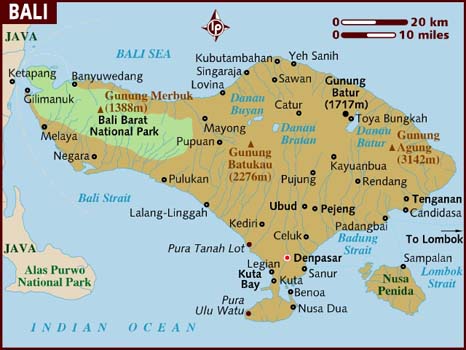
Friday 19 Feb 2010 Ubud, Bali, Indonesia
We were both glad we had opted for a guided walk through the rice paddies of
Ubud. There is no way we would have found our way without getting lost. There
are lots of rice paddies to explore around Ubud and we tried two different
areas.
We picked up a brochure advertising a walk north of Ubud culminating in a
visit to a village famous for its Balinese miniature paintings. The brochure
said it would be a 3 hour walk directly from Ubud but the company had changed
the itinerary by the time we signed up. Instead of starting directly from Ubud
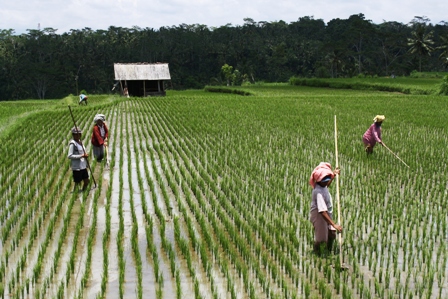
we were driven several km north and started our walk through green rice paddies.
The concrete edge of an irrigation canal near the River Wos was to be our path.
Ray and I had two guides, Mayan leading the way and young Gered bringing up the
rear. This sounded much to easy for us until we realized that you risk slipping
on the moss covering the concrete if you walk too quickly and don’t watch your
step. I was glad I had my two walking sticks with me for balance. Ray had just
one and I think he often missed the second stick.
It was a pretty walk. We waved hello to locals as they plowed and weeded
their lots. Mayan kept pointing out the fruit trees planted next to the rice.
There were banana, coconuts, guava, avocado, jackfruit, durian, papaya, mango,
and coffee trees, plus some pineapples growing beside the canal. Mayan told us
that if we were there in the late afternoon we could join many of the
townspeople in their daily bath and swim in the canal. He said he never missed
his daily bath.
We left the rice paddies and headed into the jungle, climbing down a steep
slope to a valley and up the other side where fresh spring water gushed from a
pipe just below a sacred shrine. We greeted an old man, recently widowed, who
ekes out a living making coconut oil from the many trees nearby.
After just 1 1/2 hours of walking and many stops for photos we were in the
village of Keliki and inside the family compound of Dulit, the walk organizer,
whose young son was one of our guides. Dulit is credited with reviving the
traditional minature painting. He starting teaching members of his own family
and others in his village in 1990. Now his paintings and those of other village
artists have become very popular. We had an opportunity to view many of the
works while we enjoyed a Balinese lunch prepared by Dulit’s wife.
Young Gered is already an accomplished artist as evidenced by the works he
showed us. He demonstrated how the paintings depicting traditional Ramayana
stories were produced. The image is first drawn on paper, then the outline is
inked, shading is added and finally tempera paint is applied. It is a long and
exacting process to produce a single small painting. A cousin, who lives in one
of five houses in the compound, was working on one of his creations. He
prefers to paint birds in their leafy jungle habitat.
Everyone in the extended family had a job, including the ancient grandparents
who put together pages for a photo album. One girl sat making photo frames from
bark and seed pods while another made covers for a photo album from leaves.
After more glasses of coffee and ginger tea made with slices of fresh ginger, we
said our goodbyes and drove back to Ubud.
The walk on Thursday just whetted our appetite to explore more of the area
around Ubud. Our Lonely Planet suggested three different walks you could do
yourself. We chose one promising a walk through Penestanan, an artist’s village
and a walk along the Ayung River. It sounded good. We started out before 9 AM
along the main road heading west out of Ubud. The traffic was heavy and the road
is never wide enough to accommodate the numbers of motorcycles and cars racing
through. We think people have forgotten how to walk. Everyone rides a
motorcycle.
We made it into Penestanan, walking slowing past the many shops displaying
their art work, and headed to the Sayan Terrace Hotel, where we expected to find
a path leading down to the Ayung River. A man on a motorcycle stopped and
greeted us and asked where we were headed. He introduced himself as Mayan,
meaning he is the first born of his family, and told us we were heading in the
wrong direction and promptly became our guide for the rest of the walk. We
weren’t sure about needing his services at first but it turned out well. We
would never have completed, let alone found our way without Mayan. The walk was
a bit more challenging than we had been led to expect, mostly because the
original path is now on private property and has deteriorated considerably.
Mayan led us through rice paddies back to the correct road leading to the
upscale Sayan Terrace Hotel, high above the Ayung River. A path did lead down to
the river but it detoured down a steep, muddy trail before reaching level ground
along the river. It was a beautiful valley, with jungle covered banks, terraced
fields and a river favoured by white water rafters at the bottom. There are a
few other upscale hotels in the area and private homes owned by foreigners, but
they are so hidden in the greenery you hardly notice them. Our walk along the
river ended at a dam controlling the flow of the river into the irrigation
canals for the rice fields. A long set of stone steps, built to get the rafters
down to the river, led us to the main road. Mayan called his uncle on his cell
phone and arranged to drive us back to Ubud. It was almost noon and you know the
quote Mad dogs and Englishmen. We were glad to get back and cool off in our pool
before going to lunch.