Bali Episode 2: Food Glorious Food
Click
the photo above
to see an album of photos. Close
the window to return to this page.


Read Previous:
Lovina Beach
or Next:
Biking Downhill
Tuesday 16 February 2010 Ubud, Bali, Indonesia
It seems that each town we visit has a different taste treat for us to try.
The food of Java differs from the food on the north coast of Bali and the food
in Ubud has new variations again. We need more days to sample everything.
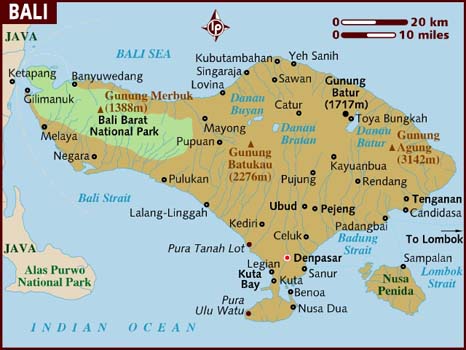
Two Aussie girls and Ray and I shared an SUV for the two hour drive over the
mountains from Lovina to Ubud, the cultural heart of Bali. Gone are the lazy
days snorkeling and sitting reading by the pool. There is too much to do in
Ubud. We have a large room with a terrace in a small guesthouse compound in the
center of Ubud, but so far we are up early and out seeing the town. We hardly
have time to enjoy the small pool at our Guesthouse.
The first day we had fresh fruit lassi and home-made banana bread in a health
food restaurant while waiting for our room to be readied. By the time we checked
in it was time for a late lunch, which we enjoyed at Casa Luna, a very good
restaurant started by Janet de Neefe, an Aussie woman who arrived in Bali in
1974 and stayed. She now runs the popular restaurant and a Guesthouse.
Just after we found a garden view table the skies opened and it began to
pour. It was a great place to wait out the storm. The food was delicious and the
ambiance lovely. Janet also runs a cooking school where guests learn to cook
Balinese dishes in the kitchen of her guesthouse. Ray wasn’t interested but
there was one place left for me the next day.
We were up at 7 AM the next day, eating breakfast on our terrace, so that I
could be at Casa Luna restaurant for 8 AM. As well as the cooking class, the
Tuesday session included a visit to the local market. Eleven of us, four
Canadians, one Aerican and six Aussies trooped behind our Indonesian guide,
Oleg, to
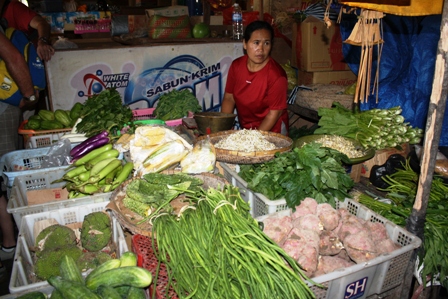
the huge Ubud market. The morning market opens about 6 AM and runs until 10 AM
when the market is transformed into the usual tourist market. The morning is the
time to be at the market. It was bustling with women buying fresh foods for the
day, having breakfast and buying snacks. Our guide explained what went into the
breakfast snacks for sale in the market. We got to sample a few. He also took us
to the spice area and pointed out the typical spices used in Balinese cooking.
He said many of the people just had to go to their gardens for their favourite
flavourings but if they preferred, everything they needed was available at the
market. We stopped at the fruit stands to sample some of the varieties we don’t
get at home. The vegetable stand had exotic greens and vegetables that are
commonplace for the Balinese.
Bali is Hindu and every family compound has a large shrine area. Offerings of
incense and banana leaf bowls filled with flowers are placed on each shrine
twice daily to welcome the good spirits. Additional small banana leaf bowls are
placed on the ground outside each home and in front of every store to ward off
bad spirits. Women sat at their booths making the banana bowls and filling them
with rose petals, lotus buds and green leaves.
The only purchase our guide made was a small bag of baby eels that are found
in the rice paddies after they are drained. They were destined to be an
ingredient in a Mie Goreng, one of our dishes we would later prepare.
Having made the rounds of the market we walked back to the Honeymoon
Guesthouse where our instructor Yuk De, a Balinese woman, was waiting with Hibiscus tea
to welcome us. She showed us how to make the tea. The stamens of red hibiscus
are removed and the flowers placed in a glass or pitcher. Boiling water is
poured over the flowers, which instantly turns the liquid black. Fresh limes are
squeezed into the liquid, transforming the colour to a cheery red. Sugar is
optional. The drink is served hot or chilled. We had pitchers of cold drink to
quench our thirst.
Balinese cooking, like Chinese, is 4 parts chopping and one part cooking. The
time consuming work of chopping the onions, garlic and peppers had been done for
us before we arrived. We had the chore of making two different sambals to spice
our dishes. We took turns grinding the ingredients into a paste using a large
stone mortal and pestle. It takes experienced cooks 10 minutes to make the
sambal. It took about 1/2 hour of our combined efforts to create the same
effect. We also had to chop some vegetables and help cook the dishes in tow big
woks.
We must have done a great job because it was all delicious. We had a tempe
curry, fish curry, white eggplant salad, another vegetable salad, fried noodles
with vegetables and of course rice. A glass of coconut wine went very well with
the meal that was topped off with a green crepe rolled like a spring roll around
a coconut and brown sugar mixture.
If any of you are interested in sampling this meal, I will need ten
volunteers and lots of exotic ingredients to help prepare the feast.
What did Ray do while I was feasting? He went for a walk and visited the
Monkey Forest Reserve where, you guessed it, there are lots of monkeys,
long-tailed macaques like the ones in the Animal Rescue Center in Thailand. He
also had a special meal. A small restaurant in the center of town specializes in
suckling pig. It is only open at lunch when customers share communal tables and
sample the delicate roast meat, accompanied by vegetables and rice.
Besides restaurants, Ubud prides itself on its artistic life. This includes
painting, carving, silver jewelry and beautiful fabrics. There are also
innumerable stores selling all these articles and they are very tempting. I
succumbed to a new blouse which I instantly put on to replace one of my almost
worn out traveling T-shirts.
The Lonely Planet had highlighted a combination shop and gallery, Threads of
Life. Ray met me after my cooking lesson and we found the shop on a quiet side
street. The store has revived the almost extinct weaving techniques on several
Indonesian islands. The samples on display in the store were museum quality.
They were mostly fabrics prepared for marriage ceremonies or special ceremonies
and involved months of work. There were videos explaining some of the methods
and showing the women at work.I loved looking at the fabrics but the prices were
beyond my budget.
Ubud is also a dance center. Several local troops take turn each night to
perform their particular variety. We attended a performance at the Ubud Palace
of a Logong group. It was richly costumed and professionally executed, even if
we didn’t fully understand the story. The performance started with the all-male
gamelan orchestra, who accompanied all the dances, performing on their own. We
are getting to lbe fans of gamelan music. A brochure given as part of our
entrance fee gave a brief explanation of the story to be performed. As is
traditional, it was part of the Ramayana story featuring lovely maidens, fierce
gods, some humorous sections and everything turning out well in the end. I would
go again.