Episode 8 Sanur AKA Snore

Click
the photo above
to see an album of photos. Close
the window to return to this page.

Read previous
Gili
Meno
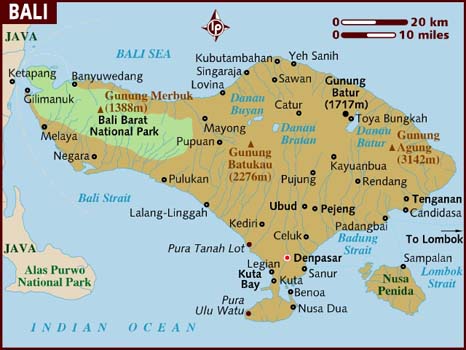
Sunday 14 March 2010 Sanur, Bali, Indonesia
We are in the ex-pat retirement capital of Indonesia, Sanur Beach, known
colloquially as “Snore”, but could be named Cottontop Center. We fit right in.
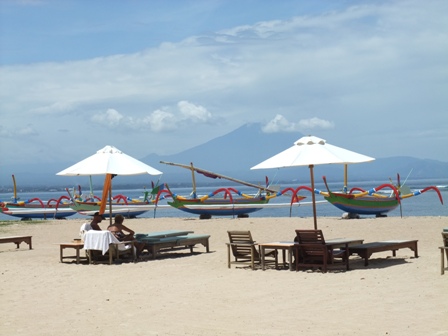
Sanur is a 5 km strip of wide, sandy Beach with a great interlock brick
boardwalk along the entire length. It is quiet, no big noisy parties, has lots
of good restaurants and lots of sunshine.
The downside is the swimming is disappointing after our easy access to
snorkeling in the Gilis and Ahmed. The reef is about 200 M offshore creating a
shallow pool next to the beach. The bottom is white sand for about 10 meters
after which the sea grasses flourish. People sunbath on loungers on the beach
but very few people swim regularly in the ocean, preferring the pools at the
hotels. We have discovered the best swimming in front of the luxurious Bali
Hyatt Hotel, right next to our more modest hotel. The entire length of the beach
and the water is public so no hotel can declare their strip of beach off limits
to the likes of us. We time our swims in the ocean with high tide so that the
water is deep enough that we are swimming above the sea weed, not through it.
Sanur Beach is also a bit upmarket, meaning the hotels and restaurants are
more expensive than our usual budget choices. We arrived by fast power boat from
the Gili Islands last Tuesday and shared a taxi with a British couple who were
staying at the Hyatt. We found a room at the nearby Jati Hotel and Homestay,
listed in the budget section of Lonely Planet. Our guidebook is three years old
and as we found elsewhere, inflation and gentrification has hit Bali. Jati,
which was originally a simple family compound, now had nicely renovated
bungalows and a small swimming pool. There was just one room left, their
superior room at 350,000 Rp (about $35 US), the most we have paid in Bali. It
was a nice room with AC and a small kitchenette but it was a hot 10 minute walk
across the busy main road and down a lane to the beach.
We started to explore our options. We could leave Sanur and return to Amed or
visit more of the mountain towns, but that would entail a long drive to get
there and return and we only had six nights left. We decided to blow the budget
and upgrade. Across the street from Jati was Peneeda View Resort with bungalows
set in nice gardens stretching from the road to their small stretch of beach.
There were three swimming pools on the premises and a nice beach side restaurant
where breakfast would be served. They had rooms at various prices and were
willing to discount the rate of their most economical bungalow because it was
still the low season. We booked a room and moved in the next day.
As expected, the room we reserved was not ready when we arrived. That didn’t
matter. We could use their facilities, swim in the pools and explore the ocean
and boardwalk. Just after the official checkout time of noon, Ray went to
inquire about the status of our room. Told it was ready, we grabbed our beach
paraphernalia and retrieved our suitcases. Oops, the concierge had made a
mistake. Our room was not ready, but would we accept an upgrade to a bungalow
closer to the beach? Did he have to ask twice? Of course we took the upgrade and
have been enjoying the amenities ever since.
What have we been doing besides lounging by the pool and walking the
boardwalk? We have found a good, inexpensive local warung (restaurant) on the
beach a short walk from Peneeda and a good local bar to have a beer and dinner.
A beach side wedding was in progress at a resort along the boardwalk as we went
for our daily stroll. An Aussie couple were tying the knot, the bride in white
and accompanied by four bridesmaids in chartreuse satin with dyed to match high
heels. A small gamelan orchestra provided the wedding music and four lovely
Balinese dancers provided entertainment for the small wedding party and the more
numerous gawkers.
The Bali Hyatt is renowned for its gardens. The hotel occupies about 300 M of
beach and stretches another 300 M to the main road. We spent a few hours
exploring the complex. There is tight security for cars approaching from the
road but innocent retirees such as us can visit any time. There are about 400
rooms in three story building arranged in squares around inner garden
courtyards. Waterways and fountains surround the public areas and beautifully
maintained gardens spread over the grounds between the street and the rooms. It
was most impressive but out of even our increased price range.
Bali is a deeply religious Hindu society. Each day flower and food offerings
are left at the private and community shrines. One of the long term guests at
our hotel suggested that the public ceremony held every Saturday afternoon at a
temple on the beach was a must see event. They were right. We were certainly
there at the right time.
Monday 15 March is the Nyepi Festival day and the Saturday prior was
equivalent to our Christmas or Easter service. Almost every Balinese Hindu was
in attendance, dressed in their best temple garb. The women wear a sarong and a
Balinese lace or embroidered blouse tied with a scarf. The men wear a white
shirt, a two layered sarong and a white kerchief tied in a ring around their
head with one corner forming a point at the front.
A sea of Balinese men, women and children sat on the beach facing the sea in
front of a raised platform filled with ceremonial offerings, surrounded by 3 M
long poles covered with thin, triangular silk banners. Prior to the service,
individual women and men added their offerings to a growing pile on a separate
table. Some people walked to the water’s edge to say some prayers and place
their offerings next to the sea. Men circulated amongst the audience sprinkling
waters over the assembled masses. One set of prayers was transmitted over
loudspeakers and the first half of the ceremony was completed.
As the first service was completing, a procession appeared bearing platters
of food and other offerings and headed for a second raised platform just to the
north on the beach next to first ceremonial spot. Following the food offerings
came men covered in hollow costumes much like the over-sized clowns at Santa
Claus parades.The difference was that the costumes depicted scary demons and
deities. There was even a long Chinese-type dragon worn by two men. Each demon
or deity was taken off their bearer and placed on the platform, facing the sea.
At the same time the worshipers who had been sitting in front of the first
platform got up and found places in front of the second platform. Security
guards approached all the tourists, who were busy photographing, to please move
to areas further from the platform. We found a small spot to sit and watch the
proceeding out of the way of the moving population. More prayers were said and
ceremonies observed. After observing the ceremonies for almost two hours, we
decided it was time to leave. We could hear the prayers continuing as we walked
back to our hotel.
We were lucky to have witnessed such an important event. Several huge Ogoh
figures, often depicting bad spirits or Ramayana figures, are being built for a
big Nyepi parade is scheduled for Monday afternoon 15 March. We met some
Canadians who have been in Sanur for the winter who have their roadside table
reserved to watch the parade. Unfortunately we will miss that. We fly at noon on
the 15th for Bangkok. If we had known the dates and significance of Nyepi, the
beginning of the Balinese New Year, we may have arranged our flights
differently. Businesses already have signs on their doors announcing they will
be closed up to three days from 15 to 17 of March. We might even have endured
Nyepi silent day on 16 March when no stores or restaurants are open, no
transport is available and activities are limited to individual homes. No one
can even go for a walk before being told by hotel security to return to your
room. But that is not possible now. We are on our way to Bangkok tomorrow and a
day later, Paris.