Episode 11: Angkor Wat and Phnom Penh
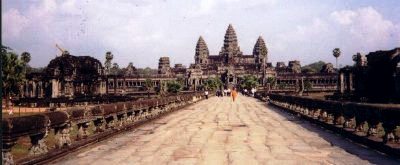
Angkor Wat
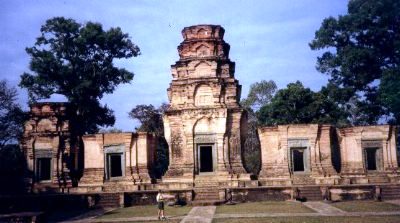
Prasat Kavan Wat, Angkor
Read Previous Episode:
Hoi An to Saigon and Mekong or Next Episode:
Sihanoukville, Ko Chang and Bangkok
Friday 21 Jan 2000
 Greetings from
Phnom Penh. Yes, the Internet has reached Cambodia and
the rates here in Phnom Penh are better than Siem Reap.
We don’t expect to be able to use email at the beaches of
Cambodia & Thailand, but you never know.
We
flew to Siem Reap via Phnom Penh and quickly found a
guesthouse. One of the other guests there suggested we go
directly to Angkor Wat to view the famous sunset. If you
buy your pass on the way, it officially starts the next
day. Like most of the guesthouses, this one had a
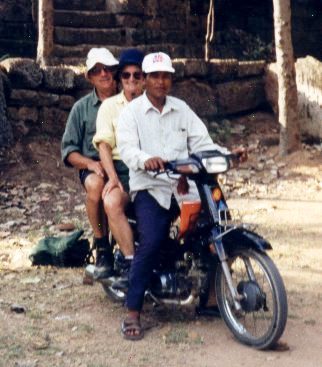
motorcycle driver ready to take us to the ruins, which
are about 6 K away. We agreed on the price and I got on
behind the driver and Ray got on behind me. We soon got
used to this method of transportation and this is how we
got around every day in Siem Reap.
 Angkor really refers to the period of the Khmer empire
between the 9th & 15th Century and is a general term
for the monuments in the Siem Reap area, for there are
far more than just Angkor Wat. My first impression of the
area as we approached on the motorcycle was that this was
Disney run amok, but it is the real thing. The majority
of the temples are in a huge park like setting in an area
of more than 15 X 5 K. You need to have transport to get
from temple to temple and you need to spread your visits
out over several days to lessen the info overload. The
temples are reputed to be especially beautiful and
sunrise and sunset and we opted to see them at sunset. I
am not at my best when I have to get up at 5 AM. The best
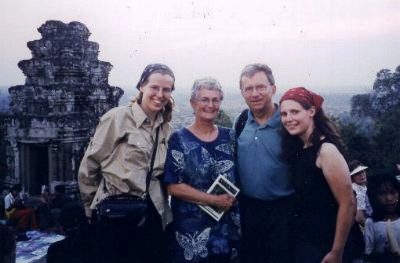
place to view sunset is at Phnom Bakheng, right opposite
Angkor Wat. Phnom means hill and this temple is built on
the only hill in this otherwise flat plain. We scrambled
to the top of the hill running the gauntlet of the
children selling cold drinks, T shirts and souvenirs and
land mine victims begging for USD. You could soon go broke if you succumbed
to every entreaty for money. Besides, we are in training
for a possible trip to India next year. The temple was
crowded with tourists all waiting for the sun to set and
of course we bumped into some we had met on our Vietnam
excursions. We traded experiences with 2 German girls,
Eva and Monica, and took their advice to buy a copy of
the book, A Guide to Angkor, from one of the children on
the site. I am sure the author would be a wealthy woman
by now if she shared in the profits of the many
photocopies of her book sold at Angkor. Anyway, it is a
very informative book and we used it religiously, rather
than hiring a personal guide at 20 USD per day. Oh, the
sunset was OK, but due to some clouds on the horizon, was
not as spectacular as the one we saw in the Mekong Delta.
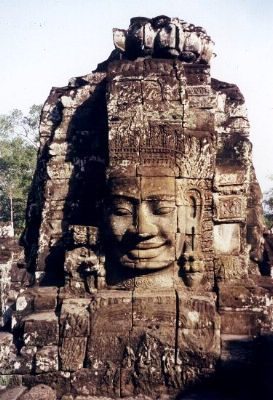
Bayan Temple
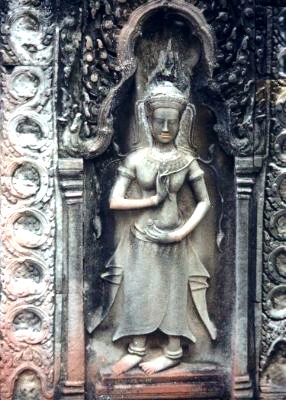
Ta Prohm carving
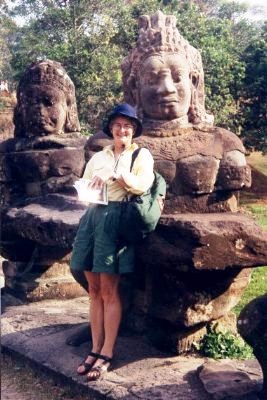
Thom South figures
I will not bore
you with details of each temple we visited but during the
next 3 days we managed to tour all the major sites and
lots more besides. By my count, we
saw more than 20 temples and there were more we skipped.
Each day on the way to other temples we admired Angkor
Wat, made more beautiful by its surrounding moat. Most of
the temples are decorated with depictions of daily life
or stories from Indian legends and are huge and comprised
of numerous buildings and rooms. They are built of red clay brick,
large square porous stone called laterite or sandstone,
which had to be carried from 45 K away. The Khmers must
have been influenced by numerology and cosmology as all
the temples are oriented on the compass coordinates and
objects are often repeated 5 times: 5 tiers, 5 serpent
heads, 5 towers. The sandstone has the most detailed
carvings with recurring themes of Nagas (multi-headed
serpents), Garudas (bird head, human body, clawed feet),
Asparas (dancing nymphs) and Sivas.
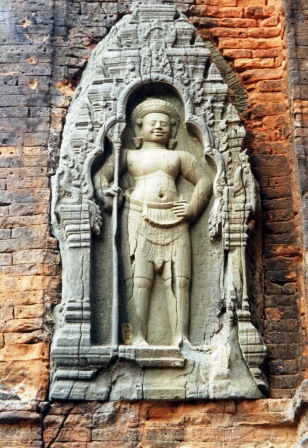
Prah Ko carving
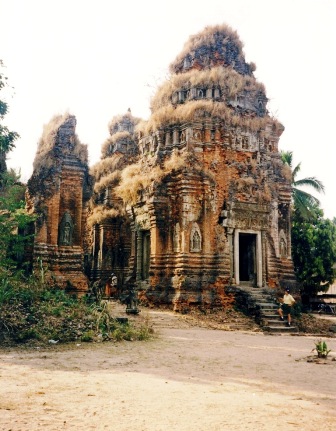
Prah Ko Temple
We took 2 out of town trips to see temples in remote
spots. One afternoon we traveled to the
Roluos
group of temples that was the home of the Kmer empire
before it moved to the Angkor site.
To get there we rode
11 K down the main road to Phnom Penh. We heard from
several of the backpackers who opted to come to Siem Reap
by road how awful their trip was and we could fully
appreciate their complaints. 11 K was far enough for us.
The temples were interesting but the trip home was a
highlight. Our guide took us over country roads through
tiny villages and hamlets for our return trip. We waved
to the villagers and rode carefully around the ancient ox
carts still in daily use. The red clay roads were much
smoother than the main highway, but boy were they dusty.
It took a lot of scrubbing at the end of the day to get
rid of the red dust.
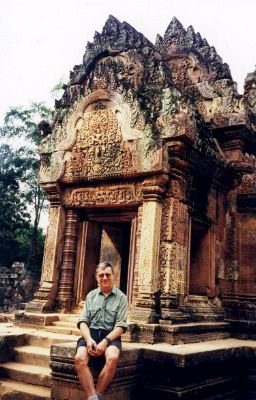
Banteay Temple
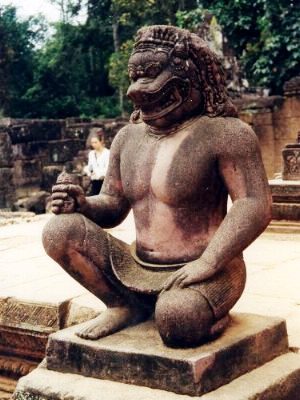
Banteay Figure
The last day, over Ray’s
initial misgivings about another long trip over dusty
roads, we
rode 25 K to Banteay Srei. We stopped for a break half
way and covered our heads with scarves, and we managed to
survive. The temple is a miniature compared to some of
the other temples, but it was encrusted with beautiful
carved figurines and carvings. This must have been the
morning to visit Banteay Srei because for the first time
we felt the effect of tour groups. Nevertheless, it was
worth the trip.
On the way back, we visited several more temples,
ending with Prah Kahn that is being restored under the
auspices of the World Monument Foundation. I wish we had
left more time to explore this site as the work that is
being done there is fascinating. Just think, for 20,000
USD you can support the restoration of a giant Garuda on
the enclosing wall of the complex and have it named after
you.
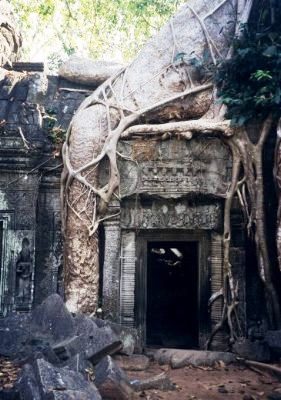
Fig tree growing over Ta Prohm temple
This
was only one of many sites that are undergoing
restorations, usually sponsored by other countries such
as France, Japan and Germany. They seem to be doing an
excellent job and are very careful to use ancient
techniques and materials wherever possible. That said,
some of Ray’s favourites were sites deliberately left in
the same state they were discovered in the 19th C with
huge trees growing out of the walls and with vines
curling over the towers.
Thursday, 20 Jan we took the fast boat over Tonle Sap
Lake to Phnom Penh. I heeded the advice of other
travelers and opted for a comfortable seat inside instead
of riding the roof. There is just the hard roof to sit on
and despite being under the hot sun for 4 ½ hrs, it gets
quite cold up there being whipped by the wind. We had an
easy ride, reading, snoozing and enjoying the scenery and
arrived in Phnom Penh before noon. We are staying in an
old French Colonial guesthouse and walking around town
enjoying the sights. The traffic isn’t as heavy as Saigon
or Hanoi and now that we are used to motorcycles, that is
our mode of taxi transport.
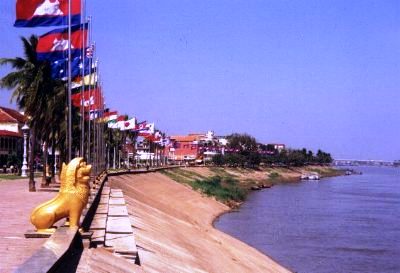
Phnom Penh River
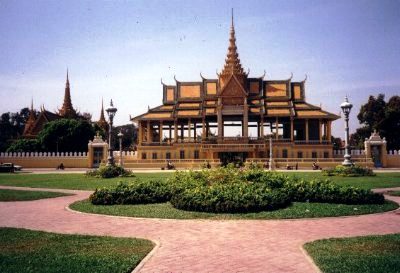
Phnom Penh Palace
Last night we ate supper at one of
the many small restaurants along the riverfront and this
morning we toured the Silver Pagoda, which is next to the
Royal Palace and set in lovely gardens. The pagoda is
named for the silver tiles which cover the floor and is
the repository of hundreds of jewel
encrusted Buddhas and other treasures. For me, a
highlight was watching a performance of traditional
dances and music by a group of children. I was told they
are orphans and that contributions were being solicited
for their welfare. I am a sucker for this type of pitch
and am apt to contribute when there is a reciprocal
service.
Before leaving Phnom Penh, we walked to the National
Museum. The National Museum was a lovely open sided
building filled with sculptures from the Angkor and other
temple ruins and brought back fond memories of our visit.
On the way there we met Margaret, an American from
Washington who had been working at an orphanage for
street kids in Manila for 3 years. Boy, are we glad we
opted for the comfortable fast boat from Siem Reap.
Margaret told us her minibus ride the day before the
‘ride from hell’. Two minibuses full of tourists suffered
because of the terrible road conditions. One of them
broke down part way there and was towed by the bus
Margaret was in. This resulted in extra body jolts as the
2nd bus was jerked along. Finally the cable connecting
the 2 buses broke, was repaired and proceeded to break
every 15 minutes. The 6 – 8 hour trip lasted 14 hours!
She also told us she had visited the orphanage in Phnom
Penh where the children who performed the traditional
dances at the Silver Pagoda live. Most of the children
are left orphans as a result of land mine accidents. She
said it had fewer facilities for the children than the
one she worked at in Manila.
We are off on the bus for Sihanoukville tomorrow. We
are told it has a nice beach and perfect swimming
temperature, so no more Wats or temples or pagodas for
now.
Return to
South-East Asian Adventures
or
Travels
or Introduction