Ray and Jeanne in Oz
Episode 3: Roads and Rocks
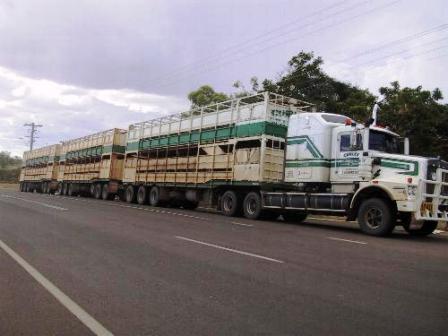
Road Train
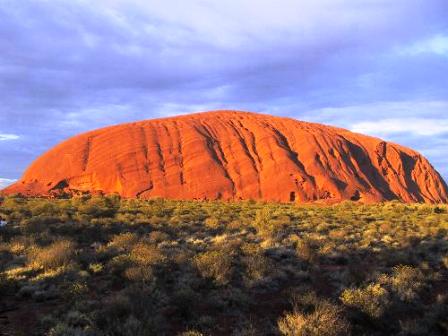
Uluru, Ayers Rock
Read previous
Corals and Coincidences
or next
Page 1 of 2
Wednesday 4
December 2003, Adelaide SA, AustraliaI have heard the
latest reports from home and winter is coming! We, on the
other hand are back to summer. Now we grumble if it cools
down at night and we have to get out our sleeping bag. We
are having a great time and the klicks are adding up; we
have driven more than 9,800 km so far, and there are long
trips to come.
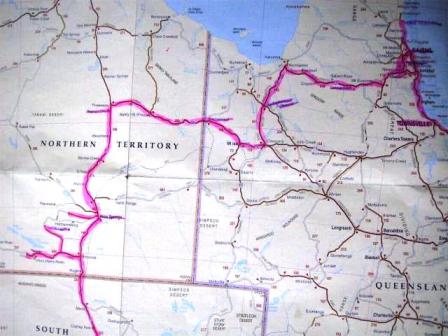
The last you heard from us, we were about to set out
from Cairns for our overland odyssey to Alice Springs. It
was an experience, but not as difficult as we had
anticipated. We didn’t rush the trip, so it took us five
days, travelling about 500 km per day, allowing time for
rest stops and time to put up our tent each day in a
Caravan Park.
 The
The
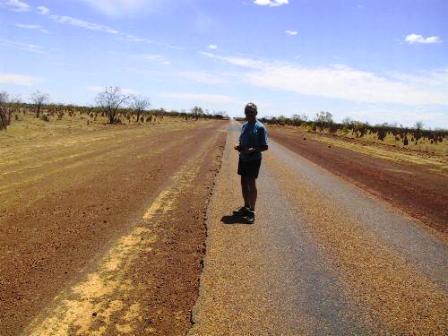
roads were all paved, but for at least 70 % of the time,
the pavement only extended to one central lane with wide
hard packed shoulders on each side. That meant that you
had to go half onto the shoulder to pass another vehicle,
which happened infrequently, traffic was sparse. The
biggest vehicles we had to pass were the Road Trains.
These are big 18-wheeler trucks hauling three regular
sized trailers full of cattle or other goods. When you
are approached by one of these suckers, you get entirely
off the road and let it roar past, each of you waving
hello.
The other obstacles you might encounter are cattle
wandering across the road, as this is open grazing
country, or the occasional kangaroo bounding to the other
side. We evolved a system whereby the passenger was in
charge of giving Moo and Roo Alerts. Consequently, we had
no unforeseen collisions, although we saw the results as
road kill all along the road.
The roads were mainly long and straight with up to 200
km between small towns. Sometimes all that existed was a
Roadhouse, the local watering hole for the residents.
Many are owned and operated by local legends and are
decorated by testimonials and memorabilia left by passing
travelers. Reading all the comments gives a colourful
history of the establishment.
The campgrounds we stayed in were on the primitive
side, although there were toilets and showers available.
By the way, if you ask where the washrooms are here, they
look at you strangely; the term is toilets. The toilet in
one campground didn’t seem to have flushed very well when
I used it the previous evening, so I gave it a pre-flush
in the morning. I let out a scream as a lime-green frog
fell from its hiding place under the toilet rim and tried
its hardest not to be flushed down. I should have been
warned. At the next campgrounds, I gave the toilet a good
kick and rattled the tank before sitting down. This time,
when I flushed the toilet, two lime green frogs fell into
the bowl and scrambled for dear life to avoid being swept
away. That was worth two screams. Ray later told me that
one toilet in the Men’s had four resident frogs. The
lesson is: always pre-flush toilets.
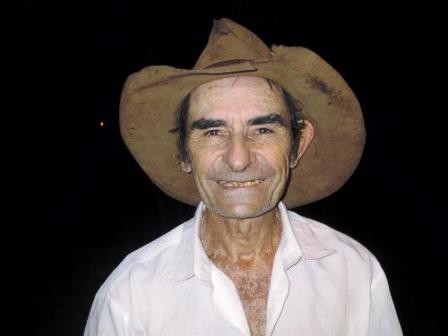
Jimmy Hooker – story teller
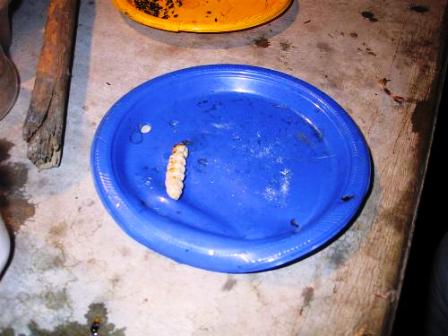
Evening treat – Witchetty Grub
Tennant Creek, our last
campsite before Alice Springs, receives our strong
endorsement – good facilities, no frogs, a shaded clean
swimming pool and entertainment in the evening. Eight of
us turned up to hear Jimmy Hooker present his Bush Tucker
(food) and Bush Talks. Jimmy is an original. He never did
learn to read or write and spent most of his life in the
bush, prospecting or driving cattle. He knows all the
edible fruits and berries and brought several varieties
along for us to sample. They were all quite tasty but the
pièce de résistance was the Witchetty Grub. This is the larva
of a huge moth, several of which were flying around our
campfire that night. Jimmy dug them out of a hollow
branch of a tree and brought them along for our dining
pleasure. He roasted them over hot coals and then invited
us to have a nibble. They tasted quite good. Some people
claim they taste like peanut butter, but I thought they
tasted like peanut butter, but I thought they were more
like buttered popcorn.
Jimmy isn’t only a Bush Tucker expert. He composes and
performs poems about his experiences in the outback, has
won at least one story telling contest, and has even
recorded a CD of his epics. He was most entertaining. One
of his poems describes his trip to town to vote in an
election. When asked for his address he had to admit he
didn’t have one. A friend waiting in line solved the
problem for him. He called out “Gumtree 69!”
and that has remained his address ever since. He has even
had mail delivered to that address.
Finally, after five days driving, we rolled into Alice
Springs (The Alice) and checked into a hostel, to sleep
in a real bed for a change. The double rooms, in old,
permanent caravans set up in the backyard, are quite
comfortable as long as you are less than six feet tall.
Alice was a pleasant town to
rest and explore. We took a day trip to the nearby West
MacDonnell National Park to hike in Ormiston Gorge, where
we saw small black-footed rock wallabies hop like cats up
the sides of the sheer cliffs.
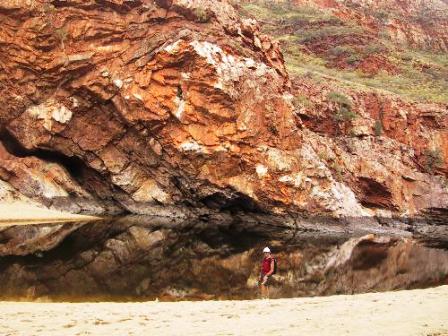
Ormiston Gorge
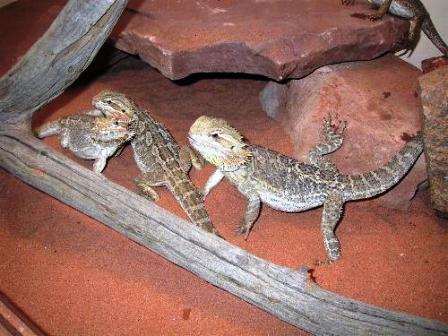
Bearded Lizards
Back in town we visited the
Reptile House, a small but interesting collection of
snakes and lizards. If you visit at feeding time, you can
hold a Bearded Dragon or a Scaley lizard and drape a
python around your neck. They claim that Bearded Dragons
make excellent house pets. They don’t shed, bark or meow,
and they eat all the bugs unlucky enough to stray into
your house. We saw how efficient they were when we fed
them juicy mealy bugs and big black cockroaches. Doesn’t
that just get your taste buds tingling?
Of course Alice was just a warm up to the biggest draw
in Oz, Ayer’s Rock or Uluru as it is more properly named.
We had heard about another attraction in the vicinity of
Uluru and decided to make a side trip to visit King’s
Canyon in Watarrka National Park. Uluru is about 400 km
SW of Alice and as the crow flies and King’s Canyon is
about 100 km north of Uluru. If you had a 4WD and the
roads were dry, you might be able to take some shortcuts,
but Priscilla is not up to those rough roads, so we took
the longer paved route, just a small 300 Km detour.
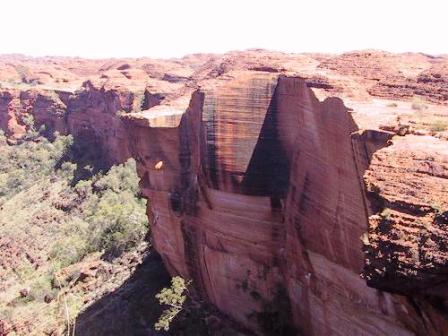 At King’s Canyon we took a
scenic rim trail around the canyon, admiring the steep
sandstone sides of the gorge and unusual beehive shaped
rock formations on the top. There is also a leafy oasis
at its base with a cooling waterhole big enough to swim
in.
We were at King’s Canyon for the night of the final
Rugby Football game between Oz and the UK. We had watched
two semi-final games at campgrounds enroute to Alice, so
we rushed through dinner in order to be at the campsite
bar to watch the game. The campground seemed almost empty
so we were surprised at the size of the crowd assembled
for the final game. It seemed to be equally divided
between Aussies and Brits, so it was a lively, friendly
crowd and the game was close and exciting. We shared a
table and some stubbies (beer in bottles) with an Aussie-British
couple we had met earlier, so it didn’t matter who we
were rooting for.
The next day we drove to Yulara, the service village,
really just the Ayer’s Rock Resort complex, about 1 Km
from the Uluru-Kata Tjuta National Park. The prices at
the resort are outrageous. Even the camping is expensive,
but at $25.20 per night, we had a bargain. We met a
Canadian couple who paid $400 per night, without meals,
for the equivalent of a Holiday Inn room. They were not
pleased, but we were fine, as the campsite facilities
were good, there was a nice swimming pool and we cooked
our own meals.
Uluru did not
disappoint us. Our first afternoon we explored the Olgas,
now properly called Kata Tjuta in Aboriginal, which
translates to ‘many heads’ . They are a collection of
huge boulders, some higher than Uluru, about 45 km away.
Like Uluru, they stand in the middle of a vast desert
plain, but they are very different geologically. Kata
Tjuta looks like someone rolled all their marbles in red
sandstone clay and gathered them together to dry in the
sun. At Uluru, someone threw a red sandstone slipcover
over a box, arranged folds artistically over the sides
and smoothed out the corners.
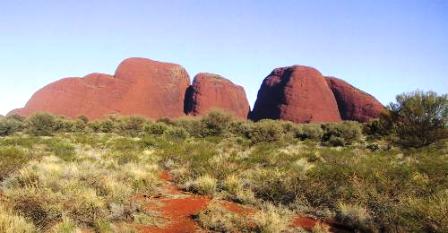
Kata Tjuta Olgas
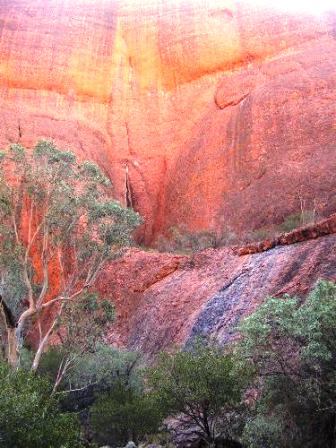
Colours of the Olga rocks
There was a nice 8 Km hike at Kata Tjuta to the Valley
of the Winds in their middle. It was
especially pleasant as we had the place to ourselves.
There is another, shorter walk at Kata Tjuta that the
majority of tour companies take their clients to. We
finished our walk and drove over to the start of the
short gorge walk. It was crawling with tour buses and
walkers, what a contrast. Ray decided there were too many
people to make it enjoyable so he waited in the shade
while I made my way past the tourists to a small narrow
gorge between the rocks. It was OK but not as nice as our
previous walk.
But back to Uluru, the main focus of the area. We
visited at sunset and at sunrise to see the colours
change on the rock with the movement of the sun, and we
walked all around the base of the rock.
Before starting the base walk, we
attended a free guided walk with a park official. We
learned more about the cultural significance of the rock
and saw ochre drawings on several of the cave walls at
the base of the rock. Uluru represents the story of
creation, according to Aboriginal dreaming stories and
was the site of many sacred ceremonies in the past. Uluru
is no longer used for ceremonies but Kata Tjuta still is,
but the reasons for the ceremonies are only known to a
privileged few of the local aboriginals. They pass the
dreamtime stories on only when and if a person in their
tribe is selected for their maturity and other special
qualities to be the next keeper of the stories.
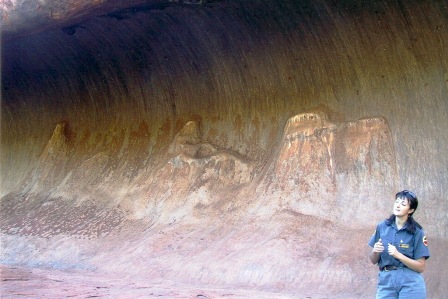
Our guide led us around Uluru
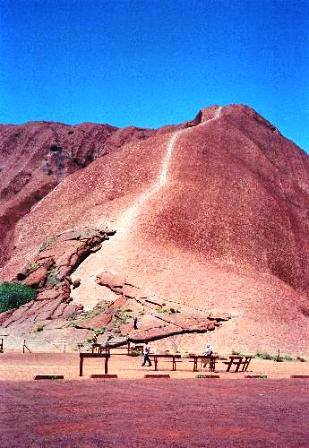
Path to the top of Uluru
I would like to say that the reason we did not climb
to the top of Uluru was because we were being culturally
sensitive, but that would be a lie. All the literature we
were given on Uluru asks you to please not climb the Rock
as the peak is the site of one of the most important male
initiation ceremonies. The
walk up is a steep one-hour climb so best done in the
early morning. We planned to climb after our sunrise
visit, but had to go away disappointed. It had been
closed that morning due to high winds at the top. At the
base of the rock are several plaques commemorating the
deaths of climbers in the past. To prevent such
accidents, the path is closed whenever it rains or the
winds are too strong. Instead of climbing, we returned to
our campsite and packed up to leave. We were still hoping
the trail would be opened before we left, but no such
luck. A few days later we met a young man who had camped
next to us. He too had been turned back from the walk,
but had managed to stay around long enough for the trail
to reopen. He said the views from the top were
spectacular. Oh well, such is life.
Next: Episode 3: Page 2
Return to
Australia Into
Return to
Travels
Return to
Introduction