Ray and Jeanne in Oz
Episode 3: Roads and Rocks
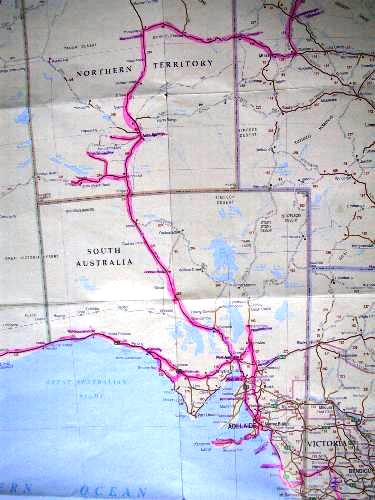
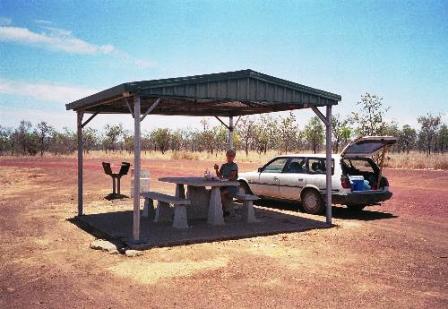
Picnic lunch on the road
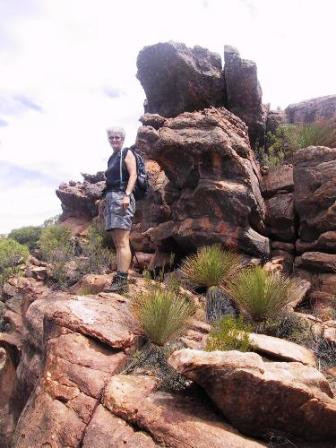
Mt Ohlssen Bagge, Flinders Ranges
Read previous
Corals and Coincidences
or next
Page 2 of 2
Wednesday 4
December 2003, Adelaide SA, Australia
Continued from Page 1
From Uluru we headed south to the Opal mining town of
Coober Pedy. Besides the opals, its claim to fame is the
underground living accommodations. Veterans of WW1 who
arrived to seek their fortune in the hot desert built the
first underground homes. Used to digging foxholes in
Europe, they burrowed underground to keep cool. The town
is not an attractive oasis in the desert, it looks like a
small dusty village. With extremely limited water
supplies, people do not plant gardens and with motels,
stores and even churches underground and about 40% of the
population living in homes dug out of the sandstone, very
little of the town is visible. According to one of the
Opal storeowners we chatted with, it is a great place to
raise your family. Everyone knows you and you never have
to worry where your kids are.
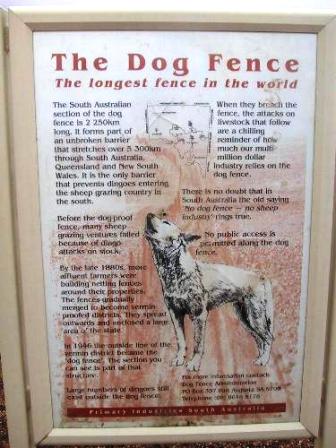
Dog Fence Sign
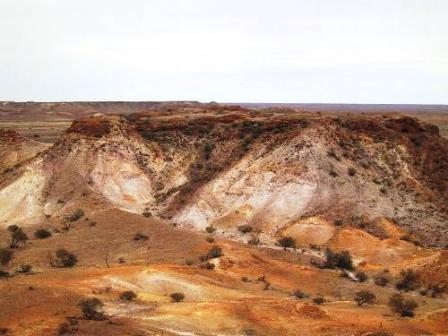
Coober Pedy Beakaway Mountains
We took a guided
tour to see some of the cave dwellings as well as the
surrounding desert. Just outside town is the famous Dog
Fence, built to separate the infamous dingoes from the
sheep. It stretches a 5400 Km long from the southern
coast of South Australia to Queensland in the east. We
also stopped to admire the Breakaways, 35 m high desert
hills carved when the inland sea receded eons ago. We visited one of
the many opal mine sites littering the landscape. No big
corporations have staked claims in the area, it isn’t
worth their while. Individual miners or partnerships sink
exploratory holes into the sandstone and spew out hills
of sand hoping for the big break. The holes are never
backfilled so walking in the area unguided is extremely
dangerous. We got to try our luck ‘noodling’ in a safe
area. That means you sift through the leftover debris by
hand looking for the shine of opal chips. A few tiny opal
chips were found by the group but not by us.
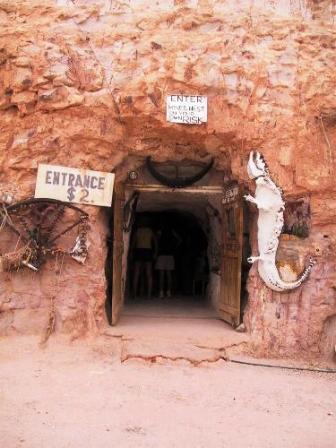
Crocodile Harry’s home
We
were also taken to visit Crocodile Harry at his mine cum
home. He is one of the colourful locals who arrived over
25 years ago to dig for opals. We wandered through the
many caverns of his defunct mine and visited his cave
home, covered with graffiti and memorabilia contributed
by previous visitors. Harry is now in his late 70s,
drinking his last years away, but he is understood and
tolerated by the locals for his eccentricities.
Coober Pedy also has a golf course. Since it is in the
midst of a desert there is no grass. The tees are
artificial turf and you get a piece of articificial to
carry around with you from hole to hole. The clubhouse is
being rebuilt after a disgruntled miner blew up the old
one. This event was taken very philosophically by Coober
Pedians, just another example of local eccentricities.
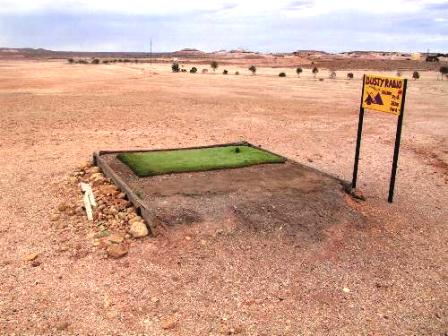
A desert golf course needs a green
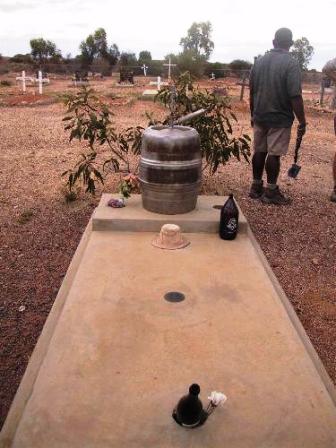
Grave with Beer Keg tombstone for
German miner
Our last stop of
the day was to Boot Hill, where our driver, an ex-miner
himself, showed us the gravesite of a German born miner.
He received the news he had terminal cancer with the
determination that everyone at his wake would have a
party. He arranged for a large beer keg to be available
for all in attendance and when the keg was empty, he had
it welded to the grave as his tombstone.
We had a graphic illustration of the convenience of a
pet Bearded Dragon when we were packing up our tent ready
to leave Coober Pedy. A large millipede skittered from
underneath the tent as we were rolling it up. It had only
3 seconds to try to scuttle away before it became lunch
for a large Bearded Dragon that suddenly appeared from
out of nowhere. Our next door tent neighbour said that a
family of these lizards live at the campsite getting fat
on leftovers, bugs and other goodies.
As you probably realize, we like to hike whenever we
can. We had read about the Flinders Ranges, reputedly one
of the most scenic wilderness areas in Oz. It was only a
few hours south of Coober Pedy, so that was our next
destination. It lived up to its reputation. We had a
great half day walk to Mt Ohlssen Bagge, for a great view
of the Wilpena Pound, a large valley surrounded by 1000 m
peaks. I was leading the way on our return trip down the
hill when I saw a snake head peeking out from a crevice
right next to the rock where I was about to put my foot.
I stopped, the snake and I exchanged glances, and I
stepped back a few paces to give the snake a chance to
escape. It wasn’t very large, but the Brown snakes in the
area are venomous. I watched my step closely after that.
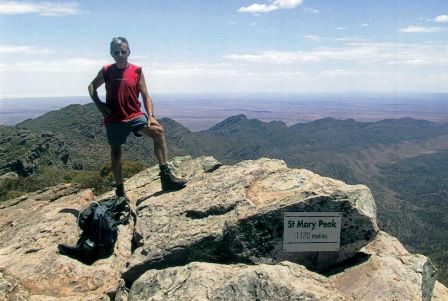
Flinders St Mary Peak
Our campsite was
right in the middle of kangaroo country and each evening
we were visited by several almost tame Roos, coming to
munch on the grassy vegetation. The next day we had our
longest walk yet to the top of St Mary Peak, one of the
highest peaks surrounding the Pound. It took us 6 hours,
round trip, to scramble up rocky paths to reach the top,
but the view was worth the effort.
There are lots of other hiking trails in the area, but
many are only accessible by 4WD. On our way south again,
we decided to drive to a few of the lookouts nearby to
have a better view of the area. As we rumbled over the
dirt road leading to the lookout, we spied a large snake
crossing the road. A Park Service Jeep was approaching us
at the same time. We both stopped and turned around to
get a better view. I asked the Park Warden what kind of
snake it was. He said it was a King Brown, the second
most deadly snake in Oz and quite aggressive. He just
wanted to make sure it got across the road safely. We
watched the snake slither into the bush from the safety
of our car. We carried on and enjoyed the views of the
Flinders Ranges, then started off again. We didn’t get
far before we had to stop again to admire the wildlife.
This time it was a pair of emus by the side of the road,
nothing dangerous.
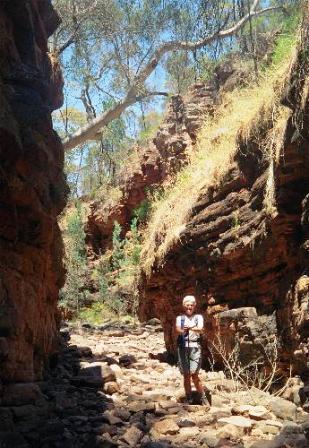
Mt Remarkable
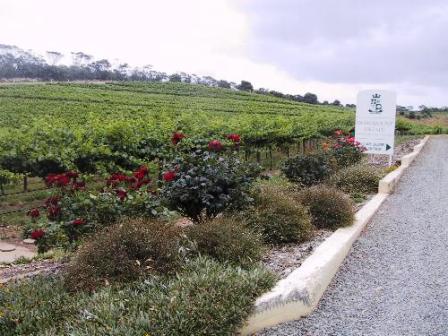
Rosemount vineyard
There is another
National Park nearby, Mt Remarkable and it sounded like a
good place to take another walk and was our route south.
The three hour hike around Alligator Gorge was pretty but
not to be compared to the Flinders walks.
From Mt Remarkable we drove through field after field
of wheat in the process of being harvested. This must be
the breadbasket of Oz. As the hills got larger, the wheat
fields changed to the vineyards of the Clare Valley.
This area is known for its Rieslings, so of course we had
to get a bottle to enjoy with our supper at our next
campsite. The next day we continued south through the
Barossa wine district. We stopped at three of the many
wineries to sample and buy a few bottles. Some of the
largest wineries are in this area, including Rosemount,
Jacob’s Creek and Penfolds.
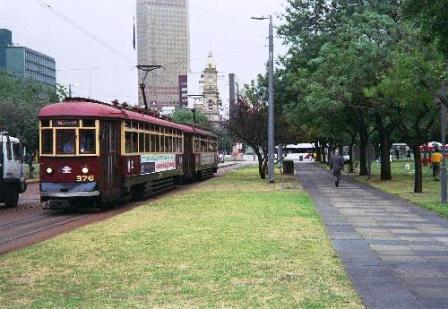
Adelaide Trolley
At last we
reached Adelaide, a pleasant town with a small downtown
area devoid of skyscrapers. Parks surround the downtown
core and beaches are nearby. All in all a good place to
linger. We are staying in a nice hostel in the center of
town, Backpackers Oz, where we were treated to a free BBQ
last evening and participated in a Pool tournament. We
were both promptly eliminated, but it was fun. I am
writing this episode on the free computers provided in
the State Library. I can book up to three hours a day, so
this is being completed over two days. We spent yesterday
afternoon wandering through the South Australia Museum,
just next to the library. They have an excellent exhibit
of Aboriginal Culture that was both informative and
entertaining.
We leave tomorrow for Goolwa, on the Fleurieu
Penninsula just south of Adelaide. We have a condo there
for one week, so we will just veg out and make day trips
to sites of interest in the area, including a winery or
two.
Return to
Australia Into
Return to
Travels
Return to
Introduction