Ray and Jeanne in Oz
Episode 5: Of Mice and More Kms
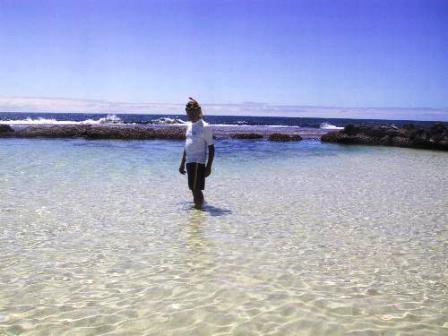
Coral Bay snorkelling at the Aquarium
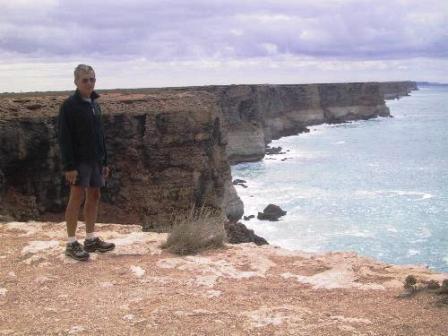
Bunda Cliffs on the Nullarbor
Read Previous
Westward Ho
or Read Next
Tassie Tales
Tuesday, January
20, 2004, Adelaide, South AustraliaThere is a joke
that Aussies only like their three B’s: Beaches, Beer and
Barbies. It is partly true, as every picnic area and
Caravan Park has at least one public BBQ and the beaches
are great, but we never encountered over indulgence in
the national drink. We did enjoy the Perth area beaches
on New Year’s Day. We joined lots of other families on a
sandy beach to swim in the waves and even found a spot to
try out our boogie boards again.
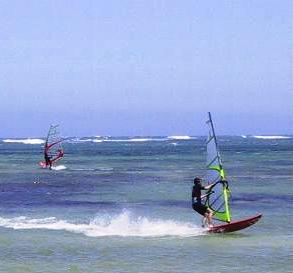
Lancelin Windsurfers
Some of the best
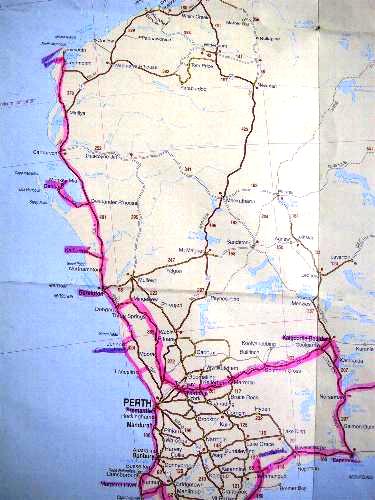
beaches in WA are north of Perth so we headed up there to
have a look. Our first stop out of Perth was Lancelin,
the perfect place for a picnic. The wind was strong off
the shore and the bay was full of windsurfers and
sailboarders. We stayed a long time watching them whip
across the waters. The sailboarders looked especially
daring as their kites allowed them to jump into the air
over the waves.
Just a bit further up the coast is the fishing village
of Cervantes. We had to retrace our steps back to the
main highway to reach it but if you had a 4WD you could
drive right along the coast. We put up our small 2 person
tent that we brought with us from Canada for the first
time in Cervantes. The wind was still
blowing so strongly we were afraid our higher 6 person
tent would take sail or be bent in half. It was cozy but
worked well. The drawing card at Cervantes, besides
fishing, is the Pinnacles, a short distance away in the
middle of a yellow sand desert. One of the best times to
view them is at sunset when the light changes their
colour. We couldn’t get over how many of these strange
pointed rock protrusions there were. They looked like a
city of people wandered into the desert and were turned
to stone for their sins. An unpaved track meanders for 3.5
km through the sandstone pillars, some reaching 5 M in
height.
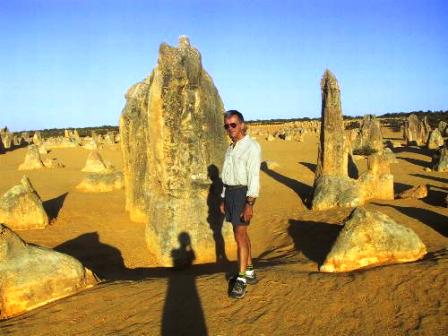
Yellow Pinnacles
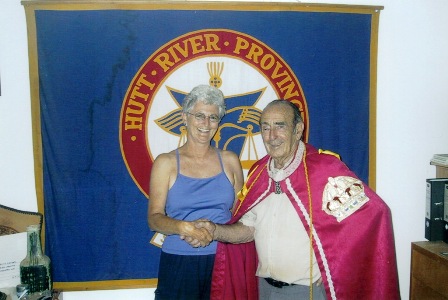
Jeanne with Len of Hutt
The next day we headed farther north to Kalbarri, a
small town on the coast with nearby gorges to
explore in a
National Park. On the way I started reading about the
Province of Hutt, just a short 35 km detour off our route.
An Aussie farmer got so incensed with government policies
that in 1971 he declared his 75 Km square property along
the Hutt River an independent state. We went to visit
Prince Len of Hutt and were welcomed warmly. Four other
people who made the visit to his principality joined us,
so he took us on the full tour. First of all he stamped
our passports with his official seal and issued us visas
for the duration of our stay. For $250 we could become
citizens of Hutt for five years, but we decided Canadian
citizenship was enough. We did buy some of his well
designed stamps and toured his museum of mementos
presented to him over the years. He opened his private
chapel to show us the paintings of biblical scenes with
the people, excluding Jesus and God, modeled on his
family members and friends. He still seems to be enjoying
his role and with three sons helping to run the farm, the
country is in no danger of disappearing soon.
Rock Lobster or crayfish are one of the main catches
along the coast so we had to try it our. We bought cooked
crayfish on our way to Kalbarri, so we had a great dinner
that night at the Caravan Park. The meat tasted the same
as lobster except there are no big front claws. The body
shell is very spiny but it is softer than lobster so it
was easier to get at the meat.
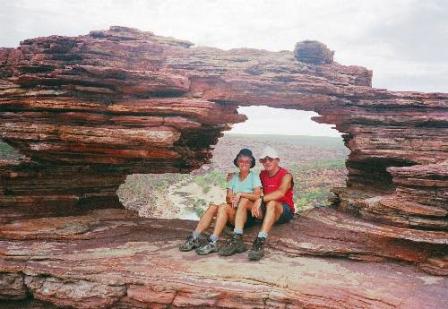 We were reminded once again the next day that Oz is a
hot country. We drove into the Kalbarri National Park to
do an 8 km Loop walk in one of the gorges around the
meandering Murchison River. The day started
out well as we hiked along the cliff tops beside the
river under overcast skies. At the half way mark we
descended to the river just as the skies started to clear.
It was a nice walk as well beside the river, but we could
have done without the end section. By that time the sun
was beating down and we were walking across boiling hot
sandbars with no shade. We were glad to reach the gorge
cliffs again where at least there was a little shade. We
were totally out of water by the time we got back to the
car but thank goodness for the emergency supply of water
we had stored for our trip to Alice Springs. We never
needed it then but it was certainly welcome now. The
moral of this tale is to start walking a lot earlier in
the morning if you are going to hike in the heat. It was
still a good hike to do.
Back at our campsite, it was time for a cooling swim
in the mouth of the Murchison River where it meets the
ocean right in the town. There were even colourful fish
to see right inshore.
Ray managed to put his personal signature on Priscilla.
He backed up too close to a tree at our campsite, so
Priscilla has one more dent to add to her collection. At
least it just affected the panel behind the back driver’s
side door and not the door itself. In fact, Ray says you
can hardly notice it in most lights.
That night we celebrated with a typical Aussie coastal
meal. Findlay’s Fish BBQ serves great fish dinners cooked
on an open Barbie. You order your meal then wait on long
picnic benches for your meal to be cooked to order. There
was so much food I doggie bagged the remainder for lunch
the next day.
Shark Bay, on a peninsula off the west coast north of
Perth, has been granted World Heritage status for four
reasons. There are vast sea grass beds, the endangered
dugongs, huge sea cows feed in the grasses, super saline
waters allow stromatolites to grow and there are
kilometers of beaches formed of compressed, broken shells.
There are lots of sharks along the bay, but none that
threatened us.
Hamelin
Pool, at the beginning of the peninsula, is the home to
one of the largest colonies of stromatolites in the world.
They look like a bunch of stumpy rocks in the water but
they are in fact living microorganisms. They exude oxygen
and were one of the earliest life forms on earth. The
high salinity in the Bay kills off any predators they
might have and the adjacent shell beaches contribute
calcium bicarbonate, an essential element to their growth.
Thank goodness there were informative signs on the
boardwalk around the stromatolites for we would have said
“nice rocks” and walked on, missing the
significance of the colony.
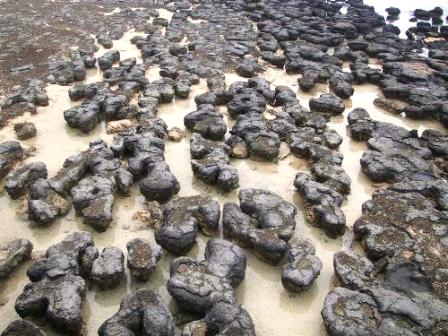
rare stromatolites at Hamelin
Pool
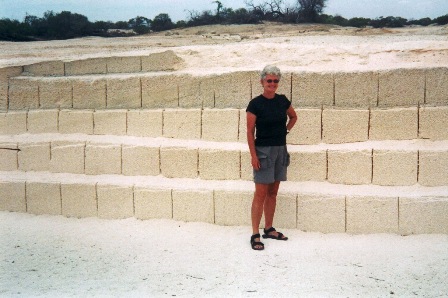
blocks carved from hardened shell
The shell on the beach is
packed so hard that local residents once cut blocks of
shells to use in house construction. The shell beach is
now protected but we saw a church built of shell blocks
in the nearby town of Denham.
At the tip of the peninsula is the resort village of
Monkey Mia where dolphins come to visit the tourists. We
went to visit for the day and this time we were lucky. We
arrived at 9 AM to be told that the dolphins were in
shore but had not been fed yet. We quickly parked the car
and rushed to join a crowd of people wading in the
shallow waters at the shoreline. There were about six
dolphins just inches from our feet; mostly females with
their babies. The staff at the resort gave a running
commentary on the dolphins while protecting us from them
and vice versa. You are not allowed to touch them for
fear of transmitting diseases, but if you are lucky you
can feed a dolphin. After about 20 minutes of swimming in
the shallows, the mother dolphins are given fresh fish as
a reward. People are chosen at random from the crowd to
hand a fish tail first to a dolphin. Young children are
the most likely to be singled out for this coveted job.
The babies are not fed because they must be trained by
the mothers to fend for themselves. After the feeding,
the dolphins go back to sea but they may return twice
more in the morning.
While waiting for a return visit we watched an
excellent video made by National Geographic on the wild
side of dolphins. We saw that dolphins are not all cute
and social sea mammals. They can and do hunt other fish
and animals in packs and have been known to kill for
sport. Flipper has a mean streak!
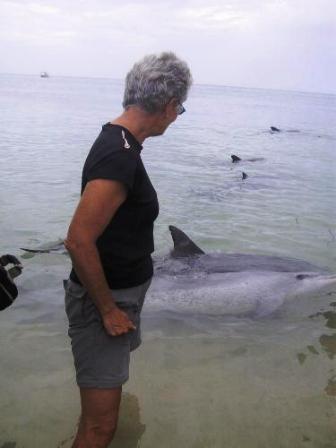
Jeanne gets to feed a dolphin,
carefully
We were relaxing
by the beach when I realized that people had gathered at
the shore again. The dolphins had returned! We hurried
down and this time, with a smaller crowd, I got to feed
one of the six dolphins that turned up! Ray was my
official photographer. We had one more turn to see the
dolphins and we had a lovely swim on the white sand beach.
It was a most satisfying day.
Our last destination on the West Coast was Coral Bay
at the southern end of the Ningaloo Reef, WA\rquote s
answer to Queenslands Great Barrier Reef. Fellow campers
where we stayed that night told us that they had just
returned from Coral Bay. They left prematurely after two
days of torrential rains. We were in luck. We did drive
through some rain the next day and we had to ford some
flooded sections of the highway, but by the time we
reached Coral Bay the sunny weather had returned and
Coral Bay did not disappoint. The reef is just offshore,
in places less than 30 M away, so you can just wade into
the warm waters with your snorkeling gear and gaze at
lots of colourful fish. We found the best spots on the
beach and even saw a turtle and a stingray.
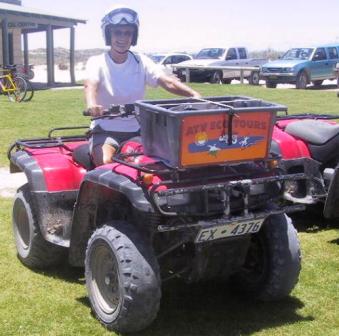
Quad bike trip at Coral Bay
We talked to one woman who
enthused about a Quad Trek to some of the beaches only
accessible by 4WD. We managed to get on a trip that
afternoon and had a great time. The Quads are motor
scooters with four big fat tires providing stability. You
can ride a Honda model alone or ride tandem on a
Bombardier. We each had our own bike. Our guide Rob led
us out slowly across a hard packed trail next to the
small airstrip and across the softer sand dunes. It
quickly became evident that one woman with her 10 year
old daughter on back was in trouble. She was terrified
and kept veering off the path in a panic. Rob solved the
problem by giving Ray his Quad and driving the tandem
with the mother and daughter on back. They were very
happy and relieved with this arrangement.
Our first stop was an area at Coral Bridge called the
Aquarium. The Reef encloses a small relatively shallow
area with waters so clear and protected that the fish
swim in a living aquarium. I swam right in the middle of
a large school of silvery fish. It was magical.
On the bikes again we took off again across the dunes
to a beach called the Lagoon. There were a few other 4WD
vehicles there, mostly fishing for the day. We were there
to swim. Rob cautioned us about the stronger current in
the lagoon but we were promised bigger fish and perhaps
turtles. Ray and I swam together to the far end and sure
enough, we followed a turtle for a short while as it
surfaced and made its way lazily through the water. We
did see lots of other fish as well, some quite a good
size.
Rob instructed us to “let her rip” on the
way back but not to go above 60 km/hr as the motors
laboured at those speeds. He led the way and we all
roared along keeping up. Ray said he reached 70 km/hr on
Rob’s more powerful machine but I only got to 65 and
pulled back a bit. It was a great area for those quad
bikes.
Back at our campsite we proceeded to pull everything
out of our car. Two days before I pulled out a bag of
rolls to make sandwiches for lunch and discovered there
was a hole bitten through the bag and a bite taken out of
one roll. We thought a bird had gotten into the car so we
threw the one bun away, double bagged it and put it back
in the car. Just before going on our quad bike trip we
discovered that we had a mouse passenger in the car. Two
buns had chunks out of them and there were mouse
droppings. The car got a well deserved cleaning out but
we couldn’t find the mouse.
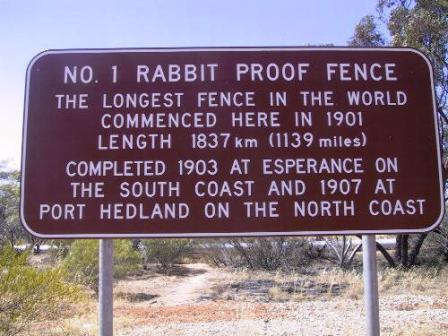
sign at remnants of Rabbit Proof Fence
That night we put
everything a mouse might nibble in our eskie and the next
day we moved on, back south and east of Perth to
Kalgoorlie-Boulder (Kal), a gold mining town. We stopped
along the road to take a photo of the last remnants of
the Rabbit Proof Fence, made familiar to us by the
excellent Aussie film of the same name. The fence was
started in 1903 to keep those pesky rabbits, an
introduced animal to Oz, away from farmers crops. The
rabbit population has dropped sufficiently that the
fences are no longer needed. The problem now is an
overabundance of Emus and I guess the fence doesn’t deter
them as most of the fences were dismantled in 2001. There
is only one section remaining a little east of Kal.
I had no idea that mining and in particular gold
mining was so prevalent in Oz. Kal was one of the richest
finds in Oz and is still a working site. With the price
of gold currently on the rise, the town is booming and
miners are in demand. We went on an excellent underground
tour of a mine that ceased operations in 1952. Our guide
was Kim, a woman from Vancouver married to a miner, so
she was a wealth of information as well as entertaining.
The original mine had 13 tunnel levels each leading to
the main vein called a stope. The first level was 100 M
below the surface and each successive tunnel was 100 M
below the next. Only the first two levels are accessible
now as the others are filled with salty ground water. The
second level is only open for inspection tours to ensure
the structural safety of the mine. We descended in an
elevator to the first level, which is fully lit and the
only level open for tours. We were shown how the mine was
worked originally under unbelievable conditions. The
miners seldom lived beyond their mid-twenties after
breathing in quantities of rock dust. We were assured
that safety is a prime consideration now but it still
remains a hazardous industry. Kim demonstrated some of
the tools used by the miners and at just 20 % of their
capacity, the noise was enough to force you to put your
fingers in your ears. The miners can make great money.
Kim’s husband, a driller with 20 years experience is in
such great demand that the two of them work only 7 months
a year. The rest of the time they visit family in Canada
and Tasmania.
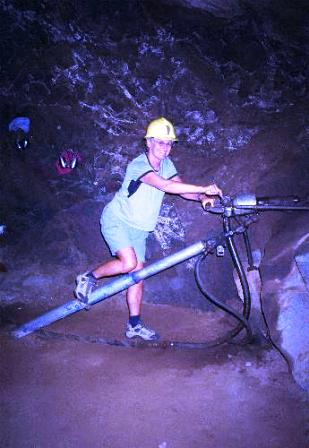
tour inside Kalgoorlie Mine
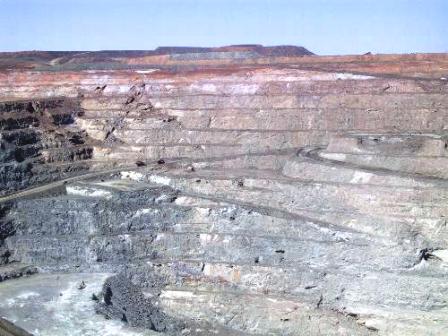
Kalgoorlie Super Pit
Kalgoorlie also
boasts the Super Pit. Some years ago an entrepreneur
bought up the remaining leases for a series of mines that
were not producing enough to make them economically
viable individually. Open pit mining was the answer. We
stood on a viewing platform above this busy operation to
watch a continual line of dump trucks fill up and drive
away to a processing plant where the gold is separated
from the rock. The open pit is now 3 km long, 1.4 km wide
and 330 m deep. The gold extracted is only 2 – 28 gms per
ton of rock but that is still enough to make the
operation viable. Of course there are heaps of residue to
get rid of so large tailing mounds are evident all around
the area. That is one of the prices we pay for gold.
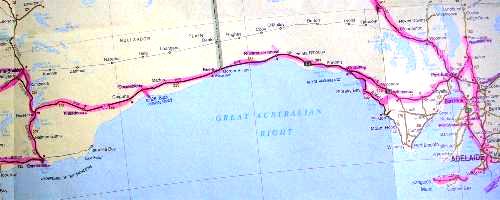
From Kalgoorlie it was back across the Nullarbor and
the mouse went along for the ride. Ray bought small
mousetraps in Kalgoorlie, but the mouse still avoided
capture. We planned to stop over part way to stay at the
Eyre Bird Observatory. We wanted to get rid of that mouse
before we left the car in a carpark for more than a day.
We had visions and returning to a mouse eaten car. Ray
bought some bigger traps and some mouse poison for good
measure. The morning we were to be driven to the Eyre
Bird Observatory, Ray came into our cabin brandishing a
dead mouse in one of the traps. That mouse’s journey
across WA was over and, knock on wood, we have seen no
further mouse evidence.
We had read about the Eyre Bird Observatory on our
trip west and given our newfound interest in birds,
decided it sounded interesting. It was. We certainly
could have spent several days there very happily. It is
run by Birds Australia as a simple lodge in an old
Telegraph station building south of Cocklebiddy on the
Nullarbor route. If you have a 4WD with good clearance
you can visit for the day, otherwise you can stay
overnight for as long as you please for $82.50 the first
night and $72.50 for successive nights, including full
board and transport the 12 Km over sandy roads to the
house. The current wardens are the most genial Ken and
Karina Harris, retired Raspberry farmers from Tasmania.
Ken does all the repairs and upkeep and Karina produces
tasty meals. There
are lots of walks to explore the area, huge white sand
dunes to climb, and a long sandy beach to walk. Fishermen
come for the fish and of course there are lots of birds.
We managed to identify several varieties we had not seen
before just sitting on the front porch. We had planned to
stay just one night and leave first thing the next
morning. We liked it so much we delayed our departure to
accompany Ken and Karina in their 4WD to do their weekly
bird count along the beach. We drove 14 km west, stopping
to count shorebirds along the way. They said there were
fewer birds than some trips but there were plenty for us.
It was a great place to spend a relaxing few days.
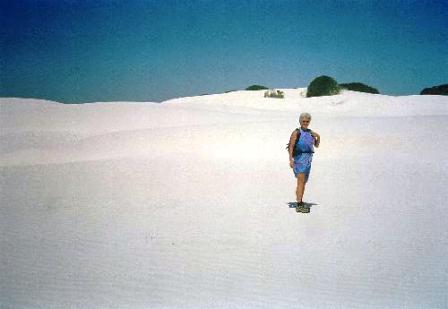
Dunes at Eyre Bird Observatory
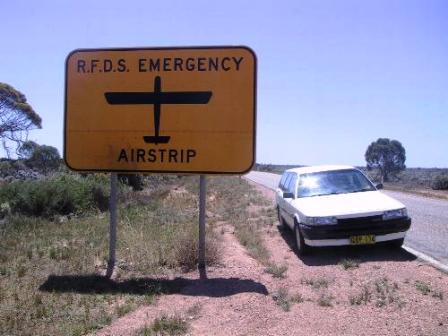
Flying Doctor can land on the road
here
Back across the Nullarbor
road we passed sections of the highway that had been
widened to allow small planes to land. The planes are
part of the famous Royal Flying Doctor Service,
established to transport people from remote communities
to the nearest medical facility.
We are now back in Adelaide before heading east to the
state of Victoria where we plan to take the ferry to
Tasmania before heading back to Sydney. Priscilla has
taken us almost 21,000 km so far and there is more to
come. We treated her to two new front tires when we
reached Adelaide, so we are hopeful she will come through
the whole trip with flying colours.
Eric and Carol Hobson are providing us with a little
bit of luxury and the use of their computer. We have had
a relaxing swim in their pool, good dinners and great
company. Maybe we can reciprocate on one of their visits
to Canada.
Return to
Australia Into
Return to
Travels
Return to
Introduction