Ray and Jeanne in Oz
Episode 2: Corals and Coincidences
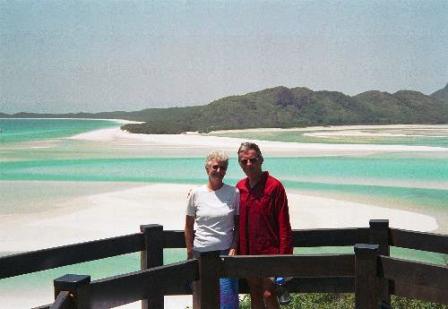
Whitehaven Beach, Whitsundays
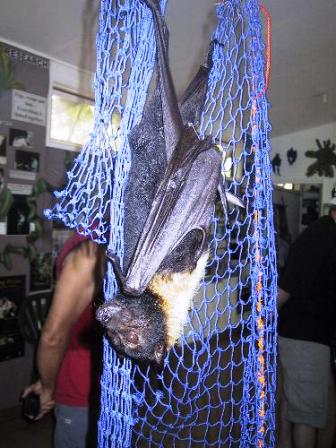
Fox Bat resting upside down
Read Previous
Beaches and Birds
or next
Roads and Rocks
Thursday 13
November 2003, Cairns QLD, Australia G’Day Mates once
again.
Unlike back home, the weather here is getting warmer
as summer nears. Along with that we are getting short
rain storms each day, but not long enough to interfere
with our plans. We have been enjoying the tropics of the
east coast.
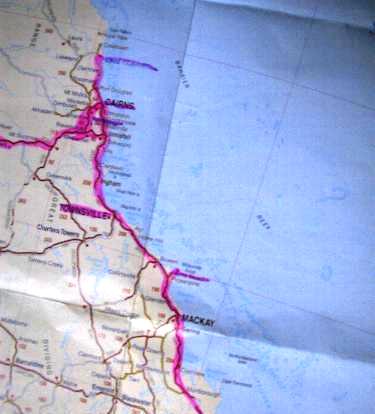
When last you heard from us we were just about to go
on a snorkeling trip in the Whitsundays. We had a nice
sunny day visiting first Whitehaven Beach, said to be one
of the world’s most beautiful tropic beaches. The sand is
that fine white silica that squeaks when you walk on it
and glistens in the sunlight. It was quite lovely and
despite having to wear a ‘stinger suit’, a one-piece
lycra and nylon suit, to protect against the possibility
of tiny but poisonous jellyfish, the swimming was fun.
The suits were only a precaution as no jellyfish were
seen, but we had a first hand account of a man who was
stung while swimming off another island a few days
previously. Therefore, better safe than stung.
The winds were quite strong in the Whitsundays, as
they have been all along the coast. We were taken to
Mackerel Bay to snorkel, rather than the preferred Hook
Island spot. Ray thought the corals were prettier there,
with more of the ‘soft’ corals but I thought the fish
population was sparse. Soft means that the corals have
anemones and other soft parts growing on them. I love the
snorkeling anyway.
 Our next stop was
Townsville, a small city on the coast. We picked a hostel
that advertised a free BBQ on Fridays, the day we were
arriving. The hostel managers were true to their word,
serving up good sausages and fixing, plus providing
entertainment from a local wildlife park. One of the
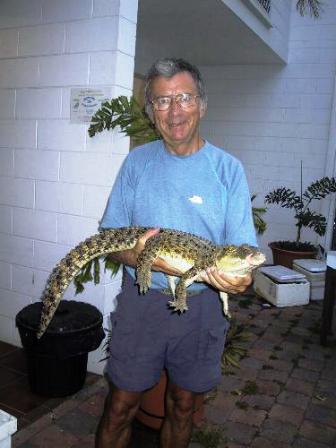
employees brought along a four year old crocodile for us
to hold, if we dared. It was only a little over a meter
in length so Ray obliged while I took his photo. He said
it was actually quite soft and not at all slimy. Luckily
they had its snout closed with a strong elastic band.
Playful nips could hurt.
One of the reasons we stopped in Townsville was to see
the aquarium, the Reef HQ. The background for the fish is
a living coral reef, with a wave making simulating the
tidal action. The fish varieties are those that can be
seen on the near by Great Barrier Reef. It was quite
impressive and our visit coincided with feeding time and
several well presented talks about the fish. We got to
touch sea slugs and star fish, called more properly sea
stars around here. We heard all about the predators of
the reef; the sharks, some carnivorous (not people) fish
and poisonous sea snakes, plus the infamous box jellyfish.
I know what to stay clear of under the water, but we were
assured the risk was extremely small. Good.
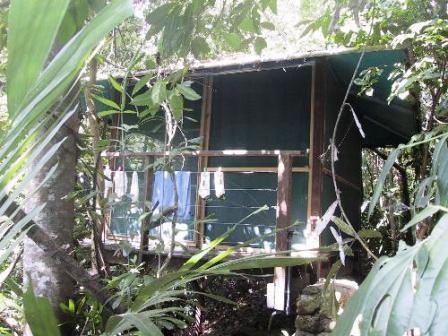 On our way north again, we headed for Bingil Bay, just
outside Mission Beach. We kept passing Cassowary Crossing
signs on the road. Cassowary are members of the ostrich
family and quite rare.
They
have a crest on their head and a blue neck, but none made
a mad dash across the road in front of us. We stayed in
the excellent Sanctuary Resort, deep in the rainforest,
in an elevated hut with net sides to enable you to get
the real feel of the forest. The resort is supposed to
have three resident Cassowaries, and I heard Cassowary
sounds when I was swimming in their pool, but none
stepped out of the rainforest for me. We had a nice
relaxed visit anyway, taking short walks in the area and
just hanging out.
A young couple from Toronto, staying at the Sanctuary,
told us to go to the Atherton Tableland to see platypus
in the wild, so the small village of Yungaburra was our
next stop. We arrived at our hostel On The Wallaby, just
about noon. The staff was rushing to finish their chores
so they could go to the local pub for lunch. It was
Melbourne Cup Day, always held on November 4. All over
Oz, people were celebrating the most famous horse racing
event of the year. I remembered a party I had attended In
Ottawa when I had worked on a project at Systemhouse with
an Aussie contracting firm. We had celebrated Melbourne
Cup Day. This sounded like fun so we asked ourselves
along.
Part of the traditional celebration is a pub crawl, so
we started off with a beer at the hostel. Suitably
prepared, four of us piled into the hostel can and drove
across the street to the local establishment for another
beer. More prepared yet, we drove a few Km farther on to
the Lake Eacham Roadhouse at a country crossroads. The
owners had brought the TV outside and has lawn chairs set
up in a circle to watch the coming event, slated for 2:10
PM. I’m told the race originally started at 2 Pm but no
one was ready then so they moved it to 2:10. Aussie
logic? A few of the local women were suitably attired in
Ascot type finery with flower bedecked hats. We paid $10
each for a cold buffet lunch and multiple glasses of
champagne, with a strawberry and optional orange juice.
Everyone bought $5 chances on a horse to win the race.
The winner was to receive $120 and your horse was
determined by a draw, so everyone had the same odds of
winning. When the race started we all cheered loudly for
our horse to win. Ours came in third, not bad, but not
the pool winner. A local B&B owner won and promptly
shared her winnings as more drinks for everyone there. It
was a great introduction to the Tablelands.
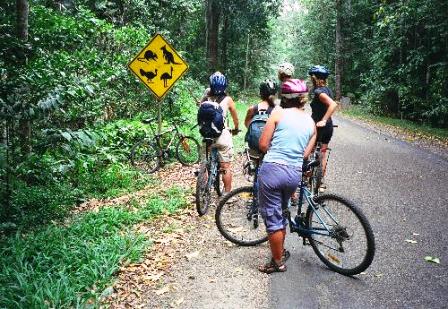 The next day we
joined the hostel guide, Steve, and several others on a
trip to Lake Eacham. Ray had a short bike ride around the
area while I walked the 3km path through the forest
around the lake. Part way around the lake I met a local
couple who was stopped peering into the bush. They told
me they were looking at the nest of a Bowerbird, and the
gentleman explained all about the bird’s strange habits
of picking whole leaves to attract a female. A bit
farther on we saw one male singing away on a nearby tree.
I said goodbye to them at the end of the trail, and took
a side trip to an interpretation center, where I learned
all about the efforts of a local group attempting to
rejuvenate the rainforests in the area. One woman
volunteer took me on a tour of their plant nursery, where
each Friday about 30 volunteers prepare and plant seeds
from local bushes and trees. It was quite an operation
and has garnered much praise for their successful methods.
By the time I rejoined the group, Ray and some of the
others had had a swim in the lake. Ray took me over to
where he had seen several turtles sunning themselves. We
were on a viewing platform over the lake when we were
joined by a group of birders, all carrying tripods and
high power scopes. Ray looked at one woman and asked
“are you from Canada?”. She shrieked and gave
him a big hug. It was Janet Castle, the wife of his
Ottawa Bicycle Club friend, Bob Trotter. We knew she had
gone on a birding trip somewhere, and that Bob was set to
join her at the end of November in Brisbane, but meeting
her was a complete surprise. On top of that, as Janet
later told us, the group had been forced to make
alterations to their original plans. They had arrived in
Melbourne a week earlier, to discover that their guide, a
Torontonian, had never even come to Australia and there
had been no reservations made anywhere for their prepaid
trip. That meant the group of 14 bird enthusiasts either
had to cancel their plans or do it themselves, at
additional expense, which they did. They flew to Cairns,
hired a big bus and drove themselves to the best birding
spots. Amazingly, they were all still in great moods. Of
course, they wanted to know what birds we had managed to
see and were super jealous of my Bowerbird spotting.
I mentioned platypus as one of the main reasons for
visiting Yungabarra. Several live in a muddy stream right
in town. To see them, you have to sneak up on them at
dusk or dawn and at this time of the year the females
stay inside their nests with their young, so only the
males come out to feed. We followed Steve to his
favourite viewing point at dusk. Janet’s birding group
was there as well (they were staying at the local hotel
in Yungabarra), and we were all pleased when one swam
across the creek before diving to cover.
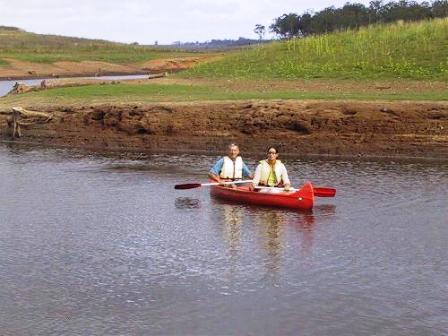 Our platypus
viewing improved the next morning when we joined Steve
again at 5:45 AM for an early morning canoe ride down a
tributary to Lake Tinaroo. The lake supplies water for
the farmers and the towns in the area, but Atherton
Tablelands has been experiencing a long period of drought
so the water levels were extremely low. There was just
enough water to paddle our plastic canoes, but luckily
the platypus have not left. We saw several swim at the
shores of the tributary. This is a favourite spot for
catching giant Barramundi fish and several fishermen were
out already, although I didn’t see any being caught.
Later that day Ray and I took several short walks in
the area to view the wildlife. We did manage to see a
Pandemelon, a small kangaroo variety, run through the
brush and we identified several marsh birds in a local
sanctuary. We saw a Musky Rat-kangaroo, sort of a cross
between a rat and a kangaroo, but our coup was on our
afternoon walk around Lake Barrine. We saw Janet and her
group later that evening and they were wild that we had
seen Chowchillas. Scooped them once again. These are
grouse type birds that only live in this area of Oz.
Janet said the group was wondering what we would see if
we ever really decided to take birding seriously:
probably nothing!
I had another scare on the walk around Lake Barrine.
We were almost finished our 5 Km circuit of the lake when
Ray called “Jeanne!” and grabbed my arm. I
slipped on the rough ground and nearly fell on a 1.5 m
long Amethystine Python, lying across the path. I scared
it just as badly and it slithered slowly into the bush.
We were up early the next day to drive to Cairns.
Janet had spoken highly of the Mareeba Wetlands,
conveniently on our route. We arrived before the gates
opened, so we made a side trip to a Mango Winery. This is
new industry in the area taking advantage of the local
mango crop and replacing tobacco for several farmers. It
was a very pleasant light wine, just the thing for our
mid-morning break!
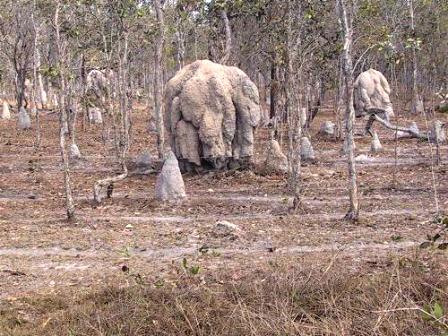 Back to the wetlands we went,
passing fields littered with termite mounds. There must
be a real problem in this area. We had a good time,
binoculars and bird book in hand, identifying more new
birds. Our favourite was the Jacana, a small marsh bird
with skinny legs and long toes. It walks on top of water
lilies, picking up the leaf edges searching for bugs.
Cairns is really quite a pleasant town. We are staying
at a nice hostel, Tropic Days, several blocks north of
the touristy downtown. It has a nice garden with a small
swimming pool, so it is a nice place to chill out.
Included in our hostel rate was a coupon for a meal in a
downtown pub. This seems to be a popular draw with the
hostels. I can’t recommend the atmosphere of the pub or
their free meals, but for a $4 upgrade, the meal was not
bad.
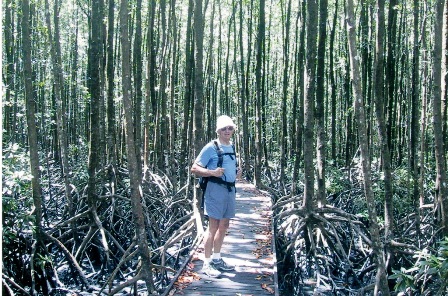 We spent our first full day
in Cairns exploring the various walks within the city. At
the airport, we followed boardwalks over a mangrove
forest and read all the informative signboards along the
way. We visited the lovely Flacker Botanic Gardens where
there were all manner of tropical plants, most helpfully
labeled. In the afternoon we returned to the Whitford
Range Environment Park to follow one of the tracks
through one of the last remaining rainforests in Cairns.
We climbed up to several views to look down over the
airport on one side and Cairns and the coast on another.
Cairns seems to have made a good effort to retain good
park areas, including the port area, which has recently
been redone with plants and pathways.
To help us understand more about the Barrier Reef, we
attended the popular Reef Teach, really a one-man show
conducted by a local diver. Although he said he has been
diving in the area for 21 years, he still retains the
broadest Irish accent I have heard in a long time. He did
know his fish and corals and was most entertaining in
imparting some of the fundamentals on his listeners.
Cairns was to have been our most northerly point but
we had heard good things about Cape Tribulation, about
150 km north. The road has been paved all the way for
about 2 1/2 years, so off we went to explore for a few
days. We stopped on the way at Mossman Gorge, on the
Daintry National Park. This is THE spot for all the day-trippers
to Cape Trib, but luckily we arrived before most of them.
We managed to have a nice 2.5 km walk around the
rainforest area and after seeing others having a great
time swimming in the streams, we got our suits and joined
them. The water was lovely and refreshing, just what we
needed after our walk.
After a picnic lunch we continued on, crossing by
cable ferry over the Daintry River and on past more
Cassowary Crossing signs. No sooner did Ray finish
remarking that some unlucky motorist must have hit a
Cassowary one day, than we saw two cars stopped just
ahead of us. A large Cassowary was stopped in the middle
of the road. We saw it look around, then casually walk
off the road into the woods. They live! and we finally
saw one!
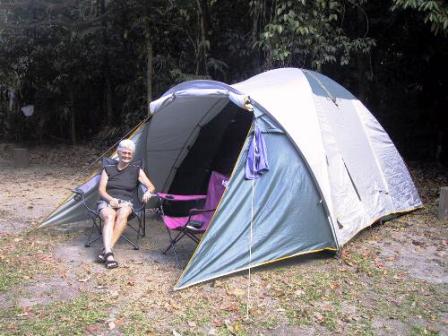 Cape Trib is
where we ceased being tenting wimps. There isn’t anything
even big enough to call a town there, just a few resorts.
The dorm and cabin rates are rather expensive in Cape
Trib but you can camp at some of the resorts. We lucked
out with our choice of Cape Trib Beach House. All the
cabins were set well apart in a wooded area and we had a
nice campsite next to one cabin, plus we got to use all
the facilities of the resort. For a bargain place it was
well set up with kitchen facilities, laundry, a bistro
and bar beside a nice pool and access to the beach. We
used the 6-person tent that came with our car. It is
huge; high enough to stand up in and room for a small
family. It really was no more difficult to put up than
our 3 man tent, but it took us a while to figure it our.
When it was finally up we got our folding chairs that
were also part of the car package and relaxed for the
afternoon.
We had
heard good things about night walks for signing all those
creatures that sleep during the day, so we signed up for
one at Cape Trib. We did see some big beetles, cicadas,
cockroaches, non-poisonous spiders, but no snakes or
possums. We did see a white-tailed rat, a white-lipped
tree frog, one of the signature creatures of a
rainforest, a forest dragon, a lizard that clings to the
side of the tree trying to look inconspicuous and a
similar river dragon. Part of the walk took beside a
creek where a few small crocodiles live, but they weren’t
very friendly that night. Adam, our leader heard one
splash into the mangroves nearby and he swore one was
lurking in the waters across the creek from us, but my
eyes weren’t good enough to pick out the crocs shining
eyes. The walk was interesting, but not the most
memorable activity.
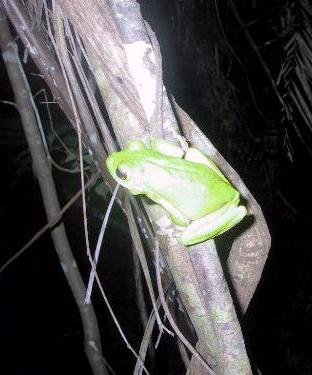
White-tipped Tree Frog
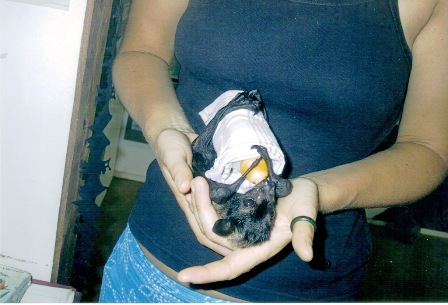
Baby Fox Bat
On our
way back to Cairns a few days later, we stopped at the
Bat House, where abandoned or injured Fox Bats are nursed
back to health. They bring in several of their tame
residents everyday for visitors to feed pieces of papaya
and pet. Yes, their thick fur is soft and cuddly. These
bats are awake during the daytime so it is no hardship
for them to be on dispay. As well as one large male, we
had four 3 week old babies to feed from small baby
bottles filled with formula. The handlers wrapped the
bottles in tea towels to give the bats something to cling
to and they suck away, upside down, on the nipples. They
told us that bats are humans closest relative in Oz. Bat
its true!
Back in Cairns, it was time to sign up for another
visit to the Great Barrier Reef. Yesterday we spent a
pleasant day on a large motor ship, Osprey V, along with
120 other snorkelers and divers. Many, like this boat
offer inexpensive introductory dives, but we just wanted
to snorkel. The reefs are close enough that you don’t
really have to dive to see the fish. The winds have been
quite strong every day so it was a rough ride out to
Hastings Reef, but neither of us was ill. We had two
stops on this reef to see the fish and although the
currents were strong, the visibility was great. I even
used one of their free prescription masks for even better
views. We saw lots of fish and some of them I could even
recognize from our fish chart and Reef Talk. Every boat
has its “Wally”, a semi-tame Giant Maori
Wrasse, and this boat was no different. One of the staff
threw fish out to entice Wally to the boat and shortly he
appeared, knowing that lunch was being served. Ray and I
even got to pet him underwater while a diver-photographer
took our picture. How could we resist buying such a
souvenir.
Tomorrow we leave on our Alice odyssey. We have
stocked up on food and bought extra water bottles and a
jerry can for extra gasoline, so we are ready to go. Wish
us a save and speedy trip!
Return to
Australia Into
Return to
Travels
Return to
Introduction