Episode 4: Jodhpur to Udaipur
Page 1
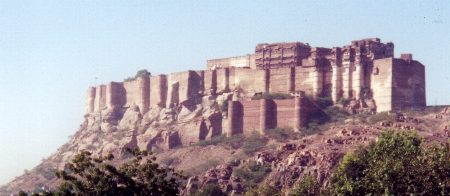
Jodhpur Fort
Read Previous Episode:
Bikaner to Jaisalmer or Next
Episode: Gujarat
Go to
Tuesday December 12, 2000 Udaipur
I
imagine everyone is right in the thick of Christmas
shopping, or at least procrastinating about it. That is
one of the pluses of travelling at this time of year: we
avoid all the Christmas hassle, but we do miss the
parties.
On the morning we left Jaisalmer more than a week ago,
I made one more attempt to read my emails. The young man
who runs the Internet shop where I had spent quite a bit
of time writing the last Episode was most helpful, but
per usual, his connection was not working. When he heard
I was leaving that morning, he asked me to sit down,
thanked me for being such a good customer and insisted I
accept a small gift. He gave me a double charm of a
Ganesh, the elephant God for good luck and Laksmi, for
good fortune. I had no idea I had made such an
impression, but of course I wished him success in his
business.
Once again, we piled on a bus headed this time for
Jodhpur, a 6 hour ride away. Not too far out of
Jaisalmer, we passed a two cart camel caravan, plodding
down the road. We had passed this same caravan on the
road when we were heading for Jaisalmer 3 days before.
I’m not sure who they were or how far they were
travelling, but the camel carts were covered on 3 sides
and the roof with fabric for sun protection and were
being driven by young Westerners, with no evidence of
Indian guides. They would probably make Jaisalmer that
day and except for travelling on a busy paved road, would
be experiencing India just like the Gypsies. Just a bit
further, we passed 2 more Westerners on bicycles, each
towing a small trailer filled with their gear. It
certainly is not common to see bicycle tourists in this
part of the world. The roads are almost all narrow, two
laned highways, paved unevenly and crowded wi th all
sorts of vehicles plus animals wandering across at random.
Not my idea of a good trip. The bus is much safer, and
that is saying something.
For one of the first times, we were unable to get a
room in our first choice of a Guest House in Jodhpur.
Instead, the owners sent us the Raman Guesthouse, a newer
business run by a brother-in-law. We got a room there and
were well taken care of for the next few days. Jodhpur’s
claim to fame, aside from the fact that Jodhpur pants
take their name from this town, is the massive fort,
Meherangarh, atop a rocky cliff in the middle of the town.
We took a rickshaw from our Guesthouse into the central
part of the city and up the steep winding road leading to
the first of seven gates leading to the fort. Unlike
Jaisalmer, this fort is not inhabited, it is run by the
current maharaja of Jodhpur as a museum. We spent quite a
bit of time just walking around the ramparts admiring the
view of the city below and of the houses painted blue,
partly to add to the tourist attraction and partly to act
as a mosquito repellant. At any rate, it does add to the
attractiveness of the city. We also toured the palace
with its ornate rooms and collections of sedan chairs,
armaments and miniature paintings.
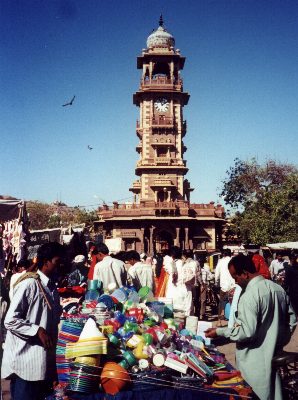 Leaving
the fort, we followed a winding back road down the old
part of the city, ending up in the crowded, busy Sardar
Market around an old clock tower. Maybe because it was a
Sunday, the place was full of local people selling and
buying everything you can imagine, from second hand
clothes and electrical supplies to fruit and vegetables.
One of the big interests for tourists is visiting the
spice vendors. One booth can claim mention in the Lonely
Planet and had a guest book where Ray found an entry from
last spring for Judy Moore, a fellow Everest Trekking
leader who lives in Oakville.
The next day, we joined five other Raman GH guests; a
Dutch couple, an English couple and a fellow from Germany
and our host, Narendra Trivedi, on a Village Safari. This
is a jeep tour to several nearby villages to see how the
majority of Indians live and to watch local craftsmen at
work. We had a little trouble getting out of town as the
main road was blocked by local truckers protesting the
recent rise in prices of gas and government fees.
Apparently this is happening all over Rajasthan, but has
not really affected us so far, apart from the fact that
the post office is also on strike and we cannot buy
stamps or mail anything. We took a bumpy detour and were
on our way to visit a Bishnoi village.
The family
compound we visited consisted of about 30 people, headed
by a Grandfather and his four sons. We were welcomed into
their homes and Narendra explained the purpose of each
building and how they lived.
These
people are not just vegetarians, they do not eat eggs as
there may be a baby chick inside, and they do not drink
alcohol or smoke tobacco. They do not even cut down trees.
They still use wood for fuel, but it must come from small
bushes, not trees.
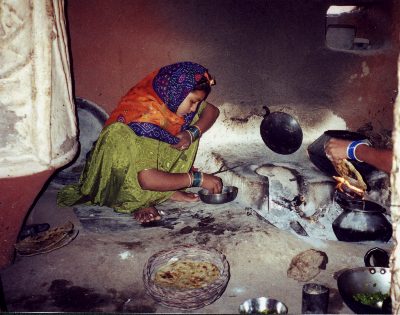
cooking in the kitchen
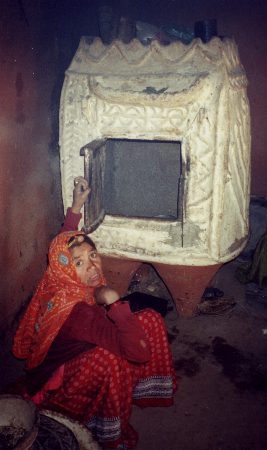
farm house oven
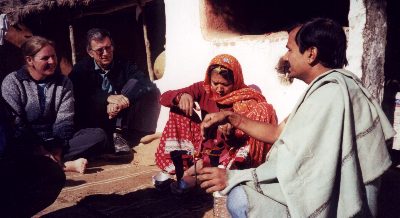 What they do though, is take opium. We
were all invited to join one of the daughters on mats on
the ground to take part in the opium ritual. Unlike our
image of opium users, the women do not smoke it, they
drink a liquid mixture as a tonic three times a day. They
did tell us the Grandfather smokes and must have his fix
every day. Our hostess ground some of the opium seed with
a pestle, mixed the powder with water and poured the
liquid through a cloth bag into a silver dish, shaped
like a shallow gravy boat.
Then one at a time, she
poured some of the liquid for us to drink into our palm.
It was very mild, a little bitter and tasted a bit like
licorice. I can’t say I noticed any effect at all, even
after several helpings, although Ray claimed he did. He
was sitting next to our hostess and got extra helpings. We had a short stop at a nearby forest and game
preserve where at least two variety of deer and some
antelope were grazing around a small lake, then it was on
to the second village.
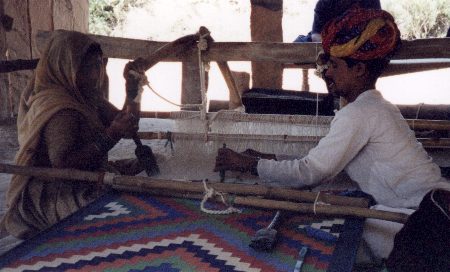 This village
specializes in hand woven Dhurrie carpets. The man who
showed us the carpets has started a cooperative of 50
weavers and has been written up in several European and
English decorating magazines. The colours and designs
were lovely and I’m probably going to kick myself for not
buying anything, but travelling light means either mail
things home at great expense and bother or carry extra
baggage. We were also served a delicious lunch here,
sampling several local variations of vegetables, lentils
and millet chapaties. There was also an interesting chili
and garlic condiment that Ray declared very tasty.
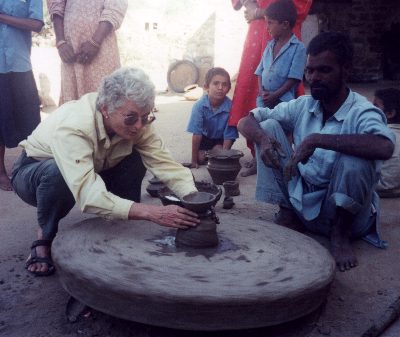
trying the pottery wheel
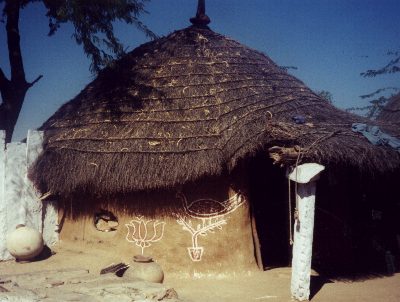
decorated farm house
Our
last stop of the day was a pottery village. One man
demonstrated his skill at throwing the clay on a hand
powered wheel and then invited us to have a try. I can
tell you my effort would end up in the recycle pile. One
of their specialties is large clay water jugs. We were
interested to watch one of the workers take a medium
sized jug and using a cradle shaped like a half eggshell
and a wooden mallet, quickly stretch the jug to twice its
original size. All the pots are put in the sun to dry for
four days and then are heated overnight in a crude
outdoor kiln.
Our
last visit was to a small textile printing operation
right next door. They use wooden blocks and natural dyes
to hand print lengths of cotton. The finished product
doesn’t cost very much in the market so I wonder how they
ever make a living at this, but they do. It was a very
interesting day.
Tuesday we were on the road again, but before we left,
our host insisted we talk to his uncle. When we first
arrived, he mentioned his uncle lived in Mississauga, and
we told him we had lived there for 6 years. His uncle is
now 75 and divides his time between Mississauga and a
home he has built in a village near Jodhpur. Ray had a
nice chat with him, so our host was pleased. In fact, he
wouldn’t let us leave without a small parting gift as
well, a small metal camel.
We travelled just over four hours by bus to Ajmer,
where we transferred to a crowded local bus going to
Pushkar. The last part of the trip to Ajmer was through a
hillier region than usual and the trip to Pushkar was up
and over the steep Snake Mountain, Nag Pahar. The bus
laboured up and down very sharp switchbacks, stopping
once or twice to let another vehicle pass us. One half
hour later we arrived in Pushkar and agreed to hire a
rickshaw to take us to a guesthouse recommended by our
Jodhpur host, Narendra. The rickshaw turned out to be a
pushcart to carry our bags, but not us. We discovered
later that all auto rickshaws are banned from the narrow
streets of Pushkar, but unfortunately, not motorcycles. I
should have listened more closely to Narendra, because we
walked out of town about 2 K before finding the
guesthouse. It was very nice, but we decided we wanted to
be closer to the action, so back to town we went. The
second place we tried didn’t have a suitable room but our
third try, a short block from where we had got off the
bus, had a room we liked, and had a restaurant on its
roof.
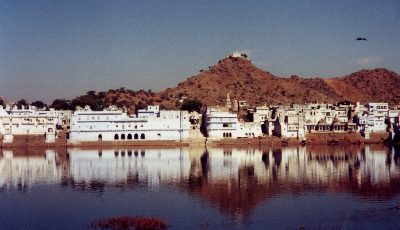 Pushkar is a delightful small
town set in a valley on the edge of the desert,
surrounding by mountains and built around a small sacred
lake. It is considered to be a very holy spot for Hindus,
hence all the restaurants stick to a strict vegetarian
menu and do not serve alcohol. This is a gathering place
for sadhus, holy men, and the site for ritual bathing at
the ghats (steps) leading down to the water. Pushkar is
the site of a huge camel trading fair in early November,
which attracts large number of tourists as well as locals
out to buy a camel. We missed that, but were very quite
taken with quiet, relaxing Pushkar, despite the largest
number of tourists, especially backpackers, we have seen
so far. The streets are lined with shops selling all the
usual souvenirs, including clothing, wall hangings,
jewelry and rugs. We spent our time in Pushkar enjoying
the scenery. That night, we splurged and had a buffet
dinner at an upscale hotel bordering the lake. Their
restaurant was on a patio overlooking the lake and our
candle lit table was close to an open fire providing
welcome heat to the outdoor diners. Very romantic.
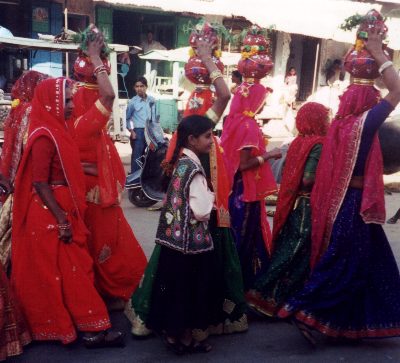 Speaking
of romance, the Indians love festivals and ceremonies and
as we have discovered, marriage ceremonies are one of
their favourites. Most Indians still adhere to the age
old custom of arranged marriages and the most propitious
time of year for this to happen is November, December and
January. We first became aware of these activities in
Jaipur as our guesthouse was near one of the favourite
wedding sites. Indians go to great expense to celebrate
with family and friends and a favourite choice is an
outdoor facility with a portable stage surrounded by
curtained walls. There is always live music, lots of food
and usually fireworks, which we witnessed every night of
our stay in Jaipur. One of the traditional paintings we
saw later in Udaipur depicted a wedding several hundred
years ago and the setting looked like the tent cities we
have seen on our travels. The difference is that wedding
celebrations used to go on for 9 days and now they are
reduced to 2 days. It is the custom for the groom and his
family to travel to the bride’s family to start the
celebrations. The groom often follows his family astride
a horse decorated with a beaded and jeweled bridle and a
blanket that reaches almost to the ground. We watched one
such parade in Pushkar wind its way through the narrow
streets. An eight piece band led the way followed by the
family in their best clothes, and the groom on his white
horse. The whole group was flanked on one side by eight
women and on the other side by eight men each carrying an
electric powered candelabra. The candelabras were strung
together with electrical cord attached to the power
source, a very large portable generator, which was so
noisy it almost drowned out the band. Our hotel in
Pushkar backed ont one of these wedding palaces, so we
were treated each evening to loud live or recorded music.
Unfortunately, we soon tired of the same tune played
repeatedly. At least they did quiet down by 11 PM.
We spent our day in Pushkar exploring the town and
climbing temple topped hills to admire the view. We
didn’t even bother with the temples, but the views were
spectacular.
Thursday we took another long bus ride to Chittorgarh,
the site of one of Rajasthan’s biggest forts. We whiled
away the time talking to the other Western couple on the
bus, Americans from Rochester. We are getting all kinds
of ideas of places to visit. This couple had spent two
months travelling in Africa before coming to India. They
did a village to village walking tour in Mali and then
did animal safaris in the Tanzania, the Serengeti and
South Africa. Like us, they travel independently, not on
an organized tour. The Dutch couple we met in Jodhpur
have also had some interesting experiences. They are
travelling for one year and started by crossing overland
through Europe and across Russia, where they did a nine
day jeep trip in Mongolia, staying in traditional yurts,
the tents of the nomads. Our travels are nothing in
comparison.
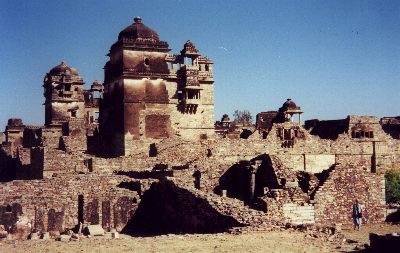 The town of
Chittor is certainly nothing to write home about, but the
fort, reached by driving more than 1 K up a steep hill,
is impressive. The town was originally situated on the
top of the hill within the walls of the fort, which
measure 7 K in circumference, but the whole area is now a
protected park open to tourists.
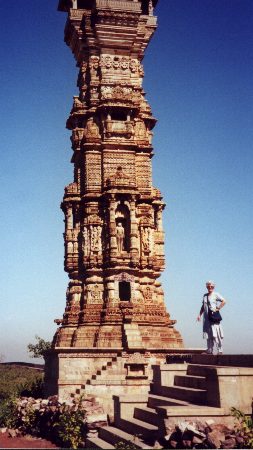 The palaces are
now deserted ruins, but are still interesting and there
are numerous temples and commemorative towers in good
shape. A lot of the mystique of Chittor originates with
the story of the beautiful Padmini, a wife of the Rana’s
uncle. A visitor to the fort, Ala-ud-din, the Pathan king
of Delhi, caught a glimpse of Padmini in a mirror and
decided to sack the fort in order to capture Padmini.
When defeat was inevitable, all the men donned saffron
robes and went out to meet the enemy and certain death.
The women and children performed jauhor by burning
themselves in a huge funeral pyre. This was the first of
three such occurrences in Chittor’s history of Rajput
wars. Anyway, we spent an enjoyable few hours touring the
fort and looking out over the countryside from the
various ramparts and gates. Ray was taking my picture at
the East gate when several village women walked by
carrying full baskets on their heads. One of the women
took her basket off and put it on my head so that I could
try it out. I didn’t drop it at least and we all had a
good laugh.
Continued…Next: Episode 4: Page 2
Return to
The India Chronicles Intro
or
Travels
or Introduction