Episode 8: Ooty to Varkala
Page 1
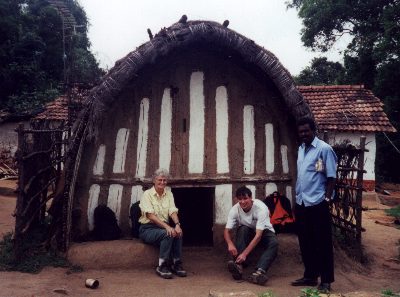
Toda house in Nilgiri hills
Read Previous Episode:
Hampi to Madikeri
Go to
Episode 8: Part 2
February 10, 2001, Varkala Beach
As
the countdown to the end of our trip begins, we can’t
help but start making plans for visiting friends and
family back in Canada. We are looking forward to seeing
everyone again, but we are not looking forward to getting
over jet lag and acclimatizing to the colder weather. We
are currently getting our bodies used to tropical
temperatures of over 30 C. We will have to keep all our
woolies handy for our arrival in Canada on Feb 13, 2001.
Meanwhile, we have been having more adventures and
experiences. We had enjoyed our few days of trekking in
Madikeri so much that we decided to travel to another
hill station, Ooty. We took the 7:30 AM, somewhat
rickety, public bus and discovered to our surprise, that
we first retraced the 3 hr trip back to Mysore. Everybody
but us got off there and a large, extended family boarded
for the 5-1/2 hour trip south to Ooty.
About an hour out of Mysore, we made our first stop at
a small roadside temple. We had arrived just in time for
the noon hour devotions and the bus driver got off to pay
his respects. Two priests approached the bus, one stayed
outside playing small cymbals and the other got on the
bus carrying a tray with incense, an oil pot, flowers and
coloured powder. He proceeded slowly down the aisle,
allowing all the passengers to make a small donation and
receive their drive-by blessings, complete with new tika
marks on their forehead. Suitably blessed, we carried on,
through two adjacent wildlife parks, Bandipur and
Mudumalai, where we saw elephants, monkeys and spotted
deer by the side of the road.
The last 49 K of the trip was the most spectacular as
we climbed the Nilgiri hills in earnest. Nilgiri means
‘blue mountain’, from the haze that often covers them.
There was a small temple on the top of a peak in the
distance and much to our surprise, the road twisted back
and forth, higher and higher, until we were far above the
temple, looking down over the jungle below us. We passed
through a huge grove of Eucalyptus Grandus and many tea
plantations, where workers were plucking the new, tender
leaves.
Finally, 9 hours after we left Madekeri, we arrived at
the Udhagamandalam (Ooty) bus station, altitude 2,400 M.
A tout, Sini, showed us his card as an officially
sanctioned guide and suggested we follow him to a nearby
hotel. Sini offered to carry my bag, so we hustled after
him down the road and up some stairs to the Mountview
Hotel. The hotel was originally an English summer home
with nicely tended gardens and the room we were shown was
large, with very high ceilings. Mountview Hotel was
typical of many of the same kind in India. There was lots
of potential if the management put as much care into the
upkeep of the rooms as they did the gardens, but instead,
everything had an air of neglect. Nevertheless, it suited
our purposes, so we agreed to stay. It got quite chilly
once the sun went down, and we needed extra blankets on
the bed to keep warm at night, but the days were warm and
sunny.
That night we discovered just how spread out and hilly
Ooty was. Like Madikeri, Ooty is sprawled over several
ridges and stairs, as well as switchbacks in the roads
connect many of the streets. We took off to find a
Chinese restaurant recommended by the Lonely Planet. It
was a lot farther than we had expected, but we were glad
to stretch our legs after the long bus ride.
 We agreed to hire Sini to take us on a trek in the
area, so the next morning, we were up and ready for him
by 9 AM at the local bus station. In typically Indian
fashion, he finally appeared at 9:30, with another
tourist, Daniel, from Luxembourg, in tow. Even then, the
three of us waited while Sini made his morning contacts
and bought a pack lunch, so it was well after 10 when we
finally boarded a bus to take us out of town to the start
of our trek. We drove 17 k back towards Mysore and got
off at a remote spot in the forest. From there we walked
through Eucalyptus and Acacia forests to a fire tower on
a hilltop clearing.
Most of the
forests in the area are the result of reforestation
efforts by the British, using native Australian trees.
They obviously suit the area and have done very well. In
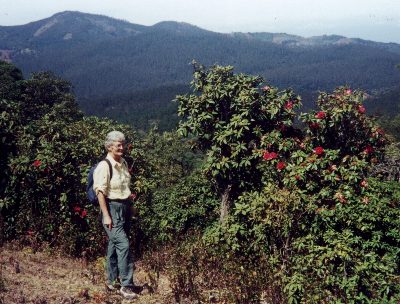
the clearing we were surprised to see several huge
Rhododendron trees covered in red blossoms. I thought it
was too early in the season for Rhodos, but not so.
We climbed the tower to enjoy a panorama view of the
surrounding countryside, which is all protected forest
with man made lakes in the center and surrounded by some
of the highest peaks in the Nilgiris. The nearby lakes,
created by damming of local rivers in the 30’s, are a
deep, green colour, the result of effluent from an animal
gelatin factory. Sini told us there are plans to clean up
the lakes, but nothing moves too quickly in India. In the
meantime, the lakes are used for boating, but they are
not safe for swimming by tourists.
We descended the fire tower and walked over to a small
Toda farm. Only about 1,500 Todas remain in the area, and
they are rapidly being assimilated into the general
population. The government has provided money to the
Todas to help build homes using traditional materials and
methods. The farm consisted of one mud farmhouse and one
traditional Toda house. The Toda house looked like a
Quonset hut with a thatched roof. The rafters were Acacia
branches and the straw for the roof was bundled and held
in place with bamboo strips. The only opening was a small
door in the center of the flat front, constructed from
eucalyptus planks and decorated with a stylized buffalo
head, which they worship, and black cross designs. We
weren’ t able to go inside this hut, as the owner was
away, but we were able to view the interior of another
one later in the day. The inside was just one room, with
a sleeping platform along one wall and simple open
shelves to hold all their stainless steel dishes along
another wall. An open cooking fire was in one corner of
the room and of course there was no chimney to let out
the smoke.
At the first Toda house, we were served tea by the
sister-in-law of the Toda house owner and shown one of
their beautiful ceremonial shawls. The shawl was like an
oversized sarong made of simple, white cotton. A panel
about one meter wide at one end was hand embroidered in
red and black designs, so that when it is wrapped around
a person, the design is displayed down their front. The
Toda women make the shawls for special occasions, such as
weddings, and nowadays, for sale in some of the markets.
The ones we saw were not for sale.
After thanking the woman for the tea, we hiked through
more forests down to the shore of the lake, where we ate
our pack lunch, then we hiked back to the road and caught
the next bus heading north. We rode a short distance to
the gates of a hydroelectric project. Sini went into the
security booth where the guards were busy playing cards,
and for a little baksheesh, got permission for us to tour
the site, normally closed to visitors. There are 12 dams
in the Nilgiri area, named Canada 1 – Canada 12, in
honour of the Canadian help and expertise that built them.
We walked past sections of pipe about 3 or 4 M in
diameter to a viewing platform at the edge of a cliff.
The government is in the process of assembling the pipe
sections in a shaft at the side of the mountain to
deliver water from a dam across the road from the gates
where we entered to the power station at the bottom of
the cliff 970 M below. This is to replace an older
system, built by the British in the 30s, which we could
see from the viewing platform. The old system had a
pipeline and a rail track to carry supplies straight down
the side of the mountain. Construction of the new
pipeline is halted now, pending the outcome of an
investigation into a fatal accident that occurred just a
few weeks ago. It seems that workers were being lowed in
an elevator in the pipeline shaft when the cables broke.
We ignored the large signs telling us that photography
was prohibited, and took a few photos of the spectacular
view from the cliff top.
 We returned to the road and
got on another bus taking a side road further into the
countryside. Here we walked a short distance to another
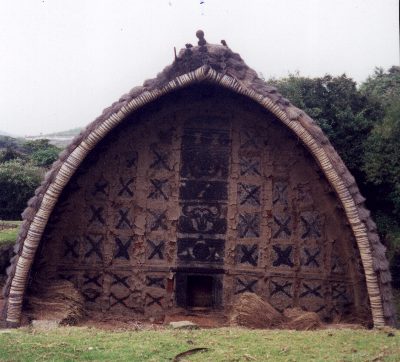
Toda village, complete with a Toda temple. If I had been
Toda, I would not have been able to come within 20 M of
the building, but foreign women are allowed to go closer,
but not go inside. The temple was the same construction
as their houses, but larger and had more decorations on
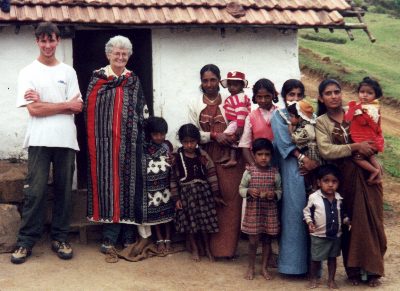
the outside. We walked over to a third Toda house, where
an extended family, friends of Sini, lived. The men were
away at special religious ceremonies, but the four sister-in-laws
invited us in and prepared yet another cup of chai for us.
 We ended up
spending quite a while with them, while
Sini was off socializing in a neighbouring cottage. We
admired the family ceremonial shawl and looked at photos
of the family posing formally in their shawls. They told
us that the shawl they had was made for their father-in-law
and it would become his funeral shroud when he died and
would be burned on the funeral pyre, along with the body.
That is why you do not see any antique shawls for sale.
Before we left, the women draped me in the shawl and we
all posed for group photos, on the proviso that I would
send them a copy.
It was after 5 PM by the time we left, but Sini wanted
to show us a forest with native Nilgiri trees, so we
followed him, bushwhacking our way through dense, thorny
bushes, ending in a tea plantation. The first part of the
tea plantation was nothing but almost leafless stumps,
the result of pruning that is done every 3 to 5 years. We
followed the paths over the hillside through un-pruned
tea plants, heading for a road on the other side to catch
the 6:30 bus back to Ooty. As we got nearer, we saw a bus
grinding up the hills, and to Sini’s surprise, this was
the bus we had intended to take, leaving 20 minutes early.
Sini confirmed with several local people that the last
bus to Ooty left at 7 PM, but it left from another
village that he pointed out in the distance. We all
hustled down a road that climbed steadily upwards until
we reached the bus stop 45 minut es later. It was then
that Sini admitted that his original intention, seeing
our elderly state, was to end our walk after visiting the
power project. He intended to send Ray & I back on
the bus to Ooty while he continued on with Daniel. He
said he changed his mind when he realized we were
experienced hikers, so we got to go along for the longer
hike, although it turned out to be much longer than even
he had anticipated.
A rickety, noisy bus turned up within 10 minutes and
we rode back to Ooty. It was dark by then so we could
only guess at the spectacular scenery we were missing.
Sini took us to a local Thali restaurant for supper on
our return. We were late to eat in this restaurant, so
two young boys who were working in the restaurant hovered
around until they could clear our plates. Sini told us
there is new legislation in India prohibiting children
younger than 16 from working. I said we had seen an awful
lot of very youthful 16 year olds around.
 January 26 is
Republic Day for India, commemorating the creation of
India as a republic. As part of the festivities, the
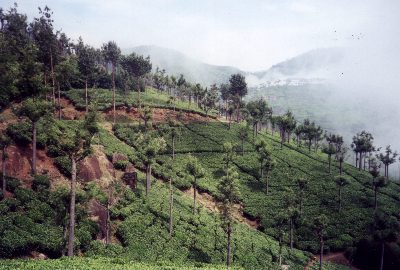
tourist department in Ooty provided a free tour of a tea
plantation and a tea factory for visitors. We joined
about 15 others in a minibus and headed down the south
side of the moun tains to Coonoor. We all admired the
lush green tea plantations covering most of the steep
hills and the numerous small villages nestled on the
ridges. Even the appearance of clouds covering the lower
valleys failed to mar our good impression of the area. We
stopped along the way to watch some of the tea pickers at
work. Workers carry large cloth sacks on their backs into
which the put the top 3 tender leaves from the tea plant.
This is a continual operation, as the entire area must be
picked about twice a month. All the leaves are brought to
the tea factory, which we visited. The leaves are air
dried to remove 50% of the moisture, rolled four times to
break the leaves down, then heated for 20 minutes in
special ovens to reduce the moisture content to 3%. The
tea is then graded according to leaf size. The largest
pieces are the top grade and the smallest, tea dust, is
what the teashops use to brew chai. We were treated to
cake and lemon tea at the factory, and then we drove to a
small hall where we were provided with box lunches.
The bus returned to Ooty, letting people off along the
way and bringing some of us to Reflections Lake at the
edge of the town. The lakeside park was crowded with
local people renting rowboats and paddleboats to go out
on the rather green looking waters. There was a stage set
up for musical entertainment and several of the local tea
businesses had displays of their products. We stayed for
a while, talking to several of the people we had met on
the tour, but the music was too loud for our tastes to
listen for long.
The next morning we took a rickshaw to the other end
of town to visit the Botanical Gardens. The gardens,
covering 20 hectares over steep hillsides, were
beautifully cared for and impressive even by North
American standards. The British established the gardens
in 1848 and included samples of nearly every type of tree
and plant growing in the area. The gardens are a
favourite spot for locals, but there was lots of room for
all of us to spread out.
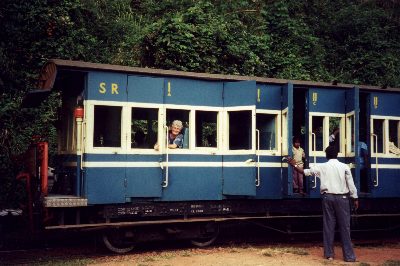 After lunch, we packed up and left to catch the Blue
Mountain railway down the south side of the mountains. We
were glad we followed advice to buy a 1st class ticket
for Rs 90, as by the time the train pulled in at 3 PM,
the platform was full of waiting passengers. We learned
later that buying the cheap Rs 10 ticket meant you were
crowded into standing room only cars, unable to enjoy the
view. There was a rush for seats, but Ray took our large
packs and I took our daypacks and managed to find a good
spot for the two of us near the window for the 3-1/2 hour
trip. The British built the train in 1898 and the
original style, if not the original carriages are still
used.
The 5 cars are
pushed up the mountain and pulled back down the 2,000 M
drop. The lower, steeper portion still uses a coal-fired
steam engine, but the train switches to a diesel for the
top half of the journey. There was a general party
atmosphere to the whole trip as every one enjoyed the
scenery. The train travels over switchbacks through tea
plantations and lush jungles and past rivers and
waterfalls. We made a few stops, where we got out to
stretch while the engines were switched and more water
was added for the steam engine. Every time we passed
through a tunnel on the way down, passengers in some of
the other cars would call out to hear their echo.
We arrived at the bottom in time to take a connecting
train to the town of Coimbatore. Rather than take the
late night train, we decided to stay overnight in
Coimbatore and take the day train to Madurai. Ray got the
impression from the ticket agent that the day train only
had hard seats or first class, so he bought us first
class tickets. When we arrived at the train in the
morning we saw that it did have the relatively
comfortable padded second-class cars, but we decided to
take it easy. I think we were the only first class
passengers and we enjoyed the ‘luxury’ of our own two-person
compartment for the six-hour trip.
Continued…Next:
Episode
8: Part 2
Return to
The India Chronicles Intro
or
Travels
or Introduction