Episode 5: All Around the State
of Gujarat continued
Page 2
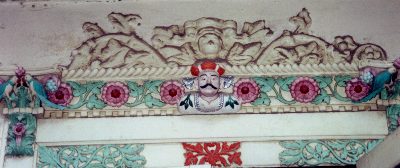
The builder’s face on a door lintel in Ahmedabad
Read Previous Episode:
Jodhpur to Udaipur or Next Episode:
Ajanta to Benaulim, Goa
Wednesday December 27, 2000 Ahmedabad
continued
from Episode 5: Page 1
 Monday
was another early start to catch the 5:30 AM bus to
Rajkot, where we changed to another bus to Junagadh. A
rather boring trip ending in the early afternoon. The
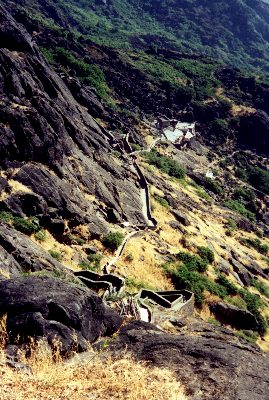
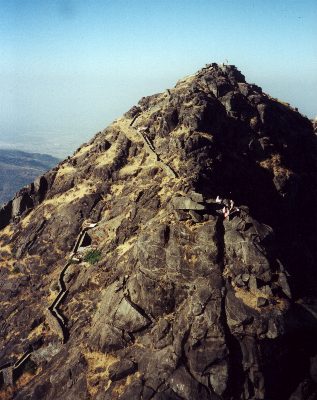
draw in Junagadh is Girnar Hill, an extinct volcano
ascending 3,300 ft from the desert floor. There are 10,000
stone steps to reach the top and starting early the next
morning to avoid the heat, we climbed every last step.
The reward at the top for us was not the temples, which
are sacred to Jains and Hindus, but the great views. When
we walked up, we were the only non-Indians around, so we
were a source of great interest for the groups of high
school kids on an excursion from Ahmedabad and a group of
college boys on school vacations. We politely answered
their favourite questions; ‘What is your country’, ‘What
is your name’, ‘How are you’, and chatted with several
who spoke quite good English.
 As a result it
became payback time for us as we posed for innumerable
photos as the foreign tourists they met on their trip.
It
took us about two hours to reach the first summit, where,
like the Adirondacks, we discovered there were two more
summits, one close by and the last reached by first
descending about 200 meters. We decided we had to do it
all, but on our way down we found out how long it had
been since our trek in Nepal. Our calves were complaining
about those 10,000 steps down, but we didn’t have to
succumb to being carried down (or up) in a portable rope
chair called a Doli.
Our plan had been to visit the Lion Sanctuary at Sasan
Gir after Junagadh, but the price hikes that have hit
other Indian tourist sites has had a huge impact on Sasan
Gir. As well as the entrance fee to the Nature Reserve
rising to $10 US each, the guesthouse rate went from Rs
150 per night to Rs 1380 and the jeep and guide fees have
skyrocketed as well. Since it is not assured that the
lions will be around and this was to be an added extra,
and not the main reason for our trip to India, we changed
our plans. The beaches at Diu all of a sudden became very
tempting, so Wednesday, we caught the 6:30 AM train (oh,
those early mornings!) to the village of Delwada.
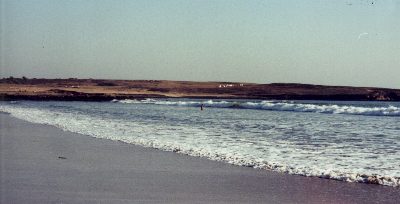 Diu, a 14 K long
island just off the southern coast of Gujarat, has not
experienced a big tourist influx and one of the reasons
is its remote location and difficulty in getting there.
Ray estimated that the train we took, one of the
remaining narrow guaged lines, averaged about 20 K per
hour. It was a long ride, the seats were hard and the
start was rocky enough to cause the two young children of
the family sharing the cubicle with us to upchuck their
breakfast. Thank goodness they were OK the rest of the
trip. In Delwada, we got a rickshaw to the town of Diu, 8K
away, then had to take another rickshaw out to the beach
area, another 8K trip, and our choice of hotel, Resort
Hoka. This was another of those trips that the end better
justify the travel and thank goodness it did. We had the
nicest accommodations so far and Nagoa beach, a two
minute walk away, was almost empty and the water was
lovely. Plus, the beer was Rs 35! It tasted good after a
long drought.
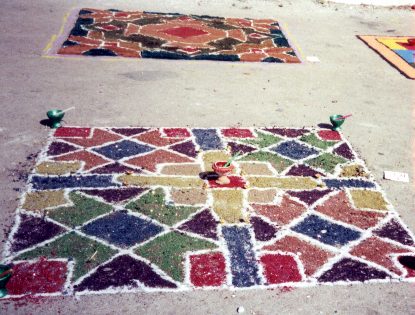 We rented a moped
to zip around the island on its uncrowded roads. The town
of Diu is a busy little fishing village that was a
Portuguese colony until 1961 when it was forcibly
‘liberated’ by India. We arrived in time for annual
Liberation ceremonies, which included a sail past of
gaily decorated fishing boats complete with firecrackers
for sound effects. At the tourist bureau officials of the
town were busy judging displays of artistically arranged
salads and sand art. Diu, which was quite tidy and clean
compared to many Indian towns, has the usual busy
vegetable market and narrow streets, plus an old fort to
explore. The fort, with its double moats and Portuguese
motifs, is mostly in ruins but was a great place to watch
the local fishing fleet leave for their afternoon fishing.
Every afternoon we rode down to a second beach, 2 K
away from our hotel, to try out our body surfing
techniques (non-existent) in the big waves. There are no
hotels or facilities on the entire 2 K length and the
only people swimming were a few Western tourists.
We had lunch after our morning swim one day at a small
restaurant on Nagoa beach. We spent the time watching a
bus load of school children and their teachers come to
explore the beach. They were typical of the other Indian
tourists we saw. First they took their shoes off and
fully clothed, waded in up to their ankles and jumped
over the small waves as they broke on the shore. As they
got braver, they gradually got up to their knees and a
few even flopped down and paddled into shore. Even the
women in their saris enjoyed letting the salt water soak
them. There were very few Indians who actually went
swimming, and I only ever saw one Indian woman in a
bathing suit.
We were getting very relaxed and into a pleasant
routine of swimming and exploring when we had to leave
the island. Christmas is the busiest time of year and we
did not have a reservation past Dec 24, so Christmas Eve
day, we were on the road again. We travelled on a rickety
old bus with no suspension over narrow bumpy roads to the
town of Palitana. The Lonely Planet description of the
trip from hell was a little exaggerated, but close.
Palitana
is a sacred pilgrimage for many of India’s Jains. They
come to climb the 3,000 stone steps to worship at several
of the 863 temples constructed on Shatrunjaya hill. After
Junagadh, this was a piece of cake, but we still started
early Christmas morning to avoid the heat of the day.
What we didn’t expect was the number of faithful. There
were thousands of people there ahead of us, all intent on
climbing those stairs. Some, especially the Jain nuns,
were even on their way down by 7:30 AM. There is the
option of hiring a Dholi to carry you up, and being the
only Westerners around and my gray hair meant we had to
fend off innumerable offers of assistance. Lots of the
older Indian people took advantage of this service,
though.
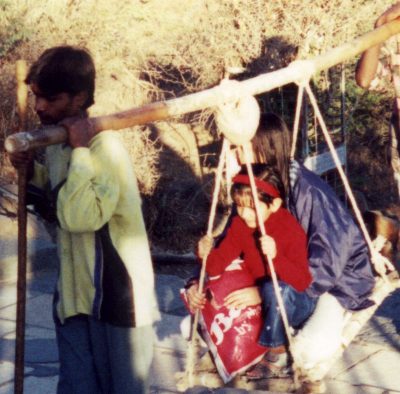
Dholi litter for rent
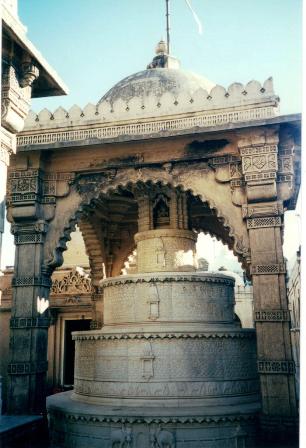
Palitan Temple
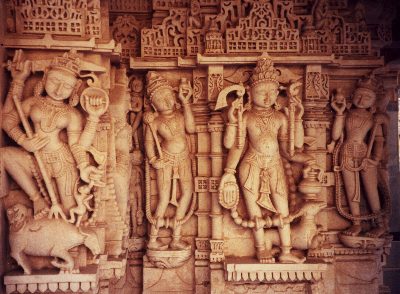
Temple Carvings
With so many
people around, we didn’t attract as much attention as we
did in Junagadh, but a few people stopped to wish us a
Merry Christmas. Most of the temples are housed in nine
fortified compounds at the top of the hill. We reached
the gates of the first compound after climbing over an
hour. Here we had to hand in our camera permission slip
and leave our shoes behind. Inside everyone was buying
trays of roses and sandalwood oil to use as offerings in
the temples, then they were lining up to enter the
biggest and most popular temple.
Many of the men
climb the hill in western clothing, then change into a
white sari-like robe for the ceremonies. The majority of
the women, except for the Jain nuns, seemed to stay in
their saris. We spent quite a bit of time at the top
exploring the various temple complexes, enjoying the
views of the surrounding countryside and observing the
faithful.
We were down at the bottom by noon and got
directed to a Gujarati Thali restaurant where we provided
some entertainment for the other local patrons. I don’t
think it was a usual tourist hang out, but the food was
good.
There wasn’t much else to keep us in Palitana, so we
joined three young women, a Canadian from Antigonish, a
German and a Belgian, who had stayed at the same
guesthouse as us, on a return bus trip to Ahmedabad. We
enjoyed talking to them on the bus and finding out about
their jobs in Ahmedabad with the Self-Employed Women’s
association (SEWA). This is Gujarat’s largest union to
promote the work of hawkers and vendors, cottage industry
workers, manual labourers and laundry and domestic
workers. This covers about 94% of women. The Canadian,
Skylan Parker, has a six month internship job with CIDA,
supposedly helping with marketing of handicrafts. She
said it has been an interesting but difficult experience.
Our time in Ahmedabad has been a combination of travel
arrangements and sight seeing. We replenished our money
supply and made several trips to the train station to
reserve seats for trips to see the caves of Ajanta and
Ellora and then onwards to Mumbai (Bombay). As well, we
decided to lighten our load by mailing home our purchases.
This is not the same as mailing a parcel in Canada. First
you have to find some one to package your parcel
according to Indian standards. One such person had a
booth set up next to the post office in Ahmedabad. For Rs
50, he cut a piece of rough cotton to size and hand sewed
it with string over my parcel. Then he melted sealing wax
over strategic spots on the seams and affixed the wax
with an official seal. Next, I had to purchase a marker
pen and write the ‘to’ and ‘from’ addresses boldly on
both sides of the package. While this was going on, Ray
scouted out the line-ups inside the post office and
determined the right queue for us to join. Luckily, it
was very short, so it didn’t take long for them to weigh
it and extract Rs 860 to send them home by boat. That is
almost $30 CAD, about the same as the total cost of my
souvenirs. I hope I get them intact.
We discovered that Ahmedabad has some interesting
spots to visit. Yesterday afternoon we had an escorted
tour of the Calico textile museum, which is a fabulous
collection of Indian handiwork housed in a lovely old
Haveli in the middle of beautifully kept gardens. Given
more time, I would have returned for a second look to
learn more about the many techniques for embroidery and
textile design.
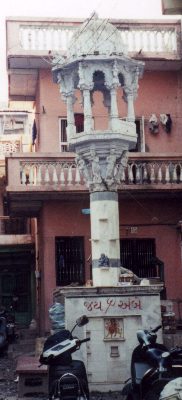
Bird Feeder
This morning we
followed the recommendation of Skylan and joined six
other tourists for a walking tour of the old city. The
tour is not mentioned in the guide books yet, but it
certainly should be. We started at the Rainbow Sherbet
coloured Swami Narayan Temple and ended at the nearly six
hundred year old Jama Masjid mosque. In between, we
followed our guide through narrow back streets while he
explained the architecture and the history of the city.
Fascinating.
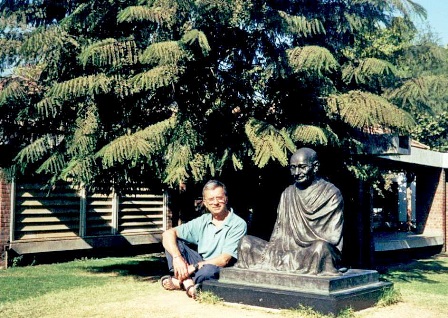
This
afternoon, we visited the Sabarmati Ashram, Gandhi’s
headquarters during his struggle for India’s independence.
It was a nice, peaceful spot next to the Sabarmati river
and displays many of the important events in Ghandi’s
life. Tomorrow is a travel day again. We will be on the
train headed to our next adventure, so stay tuned. Thanks
again for all your newsy reports and good wishes. As you
can tell, we are well and still enjoying our travels.
Back to Episode 5: Page 1
Return to
The India Chronicles Intro
or
Travels
or Introduction