Harlech: Reunion Time
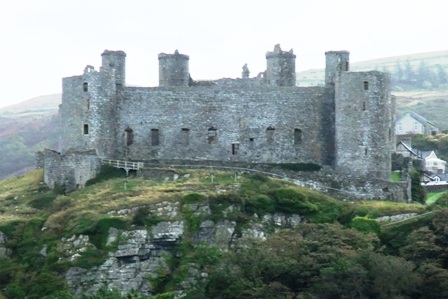
Click the photo of Harlech
Castle above to see an album of photos.To return to our
webpage, close the window
Click here to read
Llandudno, Anglesey,
Carnaervon
Crown Lodge Arrival, Harlech, Wales
13 Sept
2011
“This is
the worst weather we have ever experienced in all our years of
hiking in Wales” said a couple from Yorkshire we met on a day walk
over the hills above Harlech. High winds and rain, brought on by the
remains of a hurricane had been the norm since we arrived Saturday.
Hiking Mt Snowdon was not an option, not that we had seriously
considered this challenging climb. Short day walks were more
sensible until the weather cleared.
Luckily
we were snug and warm in Crown Lodge. The large stone house was the
original home of Coleg Harlech. When larger quarters for the
expanding school were obtained, Crown Lodge was turned into a
residence for attendees of seminars. We were able to rent the
building for a week for a very reasonable price when the Coleg
didn’t need it. We were all pleasantly surprised to find our
accommodation well above the basic level we had expected. There were
eight large double rooms with ensuite bathrooms for the seven
couples to choose from and Janet Schom took a single room with a
gorgeous view towards the Irish Sea. We had a comfortable sitting
room for our pre-dinner snacks and the kitchen had room for all 15
of us to eat together.
By 4:30
that afternoon our group of Ray and I, David and Suzanne Andrews,
Claudia and Neil Carver, Marg and Jack Dunphy, Ginny and Jim Galway,
Pat and Bruce Marshall, Cathy and Bill Pawley and Janet Schom, had
all arrived. All the women had graduated from Bishop’s University
together and two of the husbands had met their wives there. We were
to spend the next week together; exploring the area and enjoying
cooperatively prepared meals together. Claudia, Neil , Ray and I
were the cooks the first night. We had bought ingredients to make
Ray’s signature fish chowder and a green salad plus we had fresh
pears provided by the owner of a B&B where Pat and Bruce stayed the
previous night. We only had to add a few melted dark chocolate bars
for a perfect desert. Dinner that night was a happy, noisy affair,
aided by quantities of wine, beer and cider, as we all caught up on
our lives. I have to say that the standard we set for meals has been
met and exceeded since then.
The rain
stopped long enough the next morning for us to explore the town of
Harlech and vicinity. With Ray as our guide several of us set off on
a short hike across the dunes, a wildflower sanctuary owned by St
David’s Golf Club, that cover the area between Harlech Castle and
the Sea. It was much too windy to hike along the shore so we stuck
to the shelter of the dunes. Later in the day we investigated some
of the streets in the upper part of Harlech, in preparation for a
longer hike on Monday. Labelled the Ancient Styles Walk, we hiked
across sheep paddocks, climbed styles over dry stone walls and held
onto our hats at the higher open areas. At least we avoided the
rains. There were so many walking paths in the vicinity around
Harlech, our appetite for more walks was whetted. There were more
styles to climb and more pastures to cross to reach a high point
with views of the Irish Sea, Harlech Castle and the Snowdon
Mountains.
Pat,
Bruce and I spent an afternoon at Harlech Castle. It isn’t the
largest of Edward I castles in Wales but it has the distinction of
withstand a seven year siege before falling to the English during
the War of the Roses. Built using almost 1,000 English, French and
Italian workers between 1283 and 1295 on high cliffs overlooking the
Irish Sea, it is a formidable fortress. It changed hands between the
Welsh and the English several times until it was conquered by the
less defended land side and left in ruins during the Civil War in
1647.
A few of
the others had visited Harlech Castle Sunday but the high winds had
forced the closure of the castle that afternoon until our visit on
Tuesday. The winds were still high when we visited, especially on
the south facing rampart. We three crouched down beside the rampart
wall and made it to a more protected side holding on to a convenient
railing. We admired the view over the dunes facing the sea. When the
castle was built a 200 ft staircase led from the castle to access to
the sea. Now the castle appears marooned as changing weather
conditions over the last two centuries have crated sand dunes
stretching ½ mile to the coast. The land is now home to St David’s
Golf Club and walking paths we explored the previous Sunday.
Others in our group have traveled to
Portmeirion, Chester, Caernarfon and followed scenic routes through
Snowdonia National Park. Everyone has returned with enthusiastic
reports of their excursions.
Welsh Rarebits
18 Sept
2011
What can
be more Welsh than a Men’s Choir? What about Welsh Cheddar Cheese on
toast? Learning to pronounce those unpronounceable Welsh place names
or learning about the ongoing struggle for political and linguistic
independence, not to mention walking the thousands of trails over
the countryside? We managed all that and more in our much too short
ten days in Wales.
Caernavon
was the first town we noticed that all the locals did truly prefer
to speak Welsh amongst themselves, but they always switched
willingly to English when we asked a question. I don’t think I ever
learned to properly pronounce place names. How do you pronounce
Betws Y Coed, and what does it mean? I called it Betty’s a Co-ed? I
hope now Welsh person heard me massacre their language. Lamb stew
and Shepherd’s pie were on our menus. We ate Welsh cheddar for
snacks and in sandwiches, used leeks, the national flower of Wales,
instead of onions in all our dinners and had a feast of Fish and
Chips for our last meal.
History
was made real for us on a visit to the Llechwedd Caverns Slate Mine.
We took both of the tours offered, one on a narrow gauge railway on
the same tracks used to haul huge slabs of slate from the depths of
the mine to be split into roof tiles. Our guide directed us to three
different caverns where tableaux with recorded voices told the story
of miners in 1860. A team of four family members, two men inside
quarrying the slate and two men outside splitting the stone, worked
an individual cavern. Few of the men survived past 45, laid low by
silicosis. We also descended 400 ft into caverns used in 1846 and
walked the low, narrow corridors from one cavern to another. It was
a good thing we all wore hard hats.
We read
all the informative panels in the castles to learn the history of
the Welsh in their struggle to gain independence from the British.
Friday night after supper several of us walked to Harlech castle to
watch the first ever, in Harlech, story of Olwain Glyndwr. He was
the last native Welshman to hold the title of Prince of wales.
Beginning in 1400 he led a revolt against the British and managed to
keep control of Harlech Castle from 1404-1409 before ultimately
being defeatd. The townspeople, some in period costumes, assembled
at Coleg Harlech, who own Crown Lodge where we stayed, and walked
along the beach by torchlight following men acting the parts of
Olwain and his men. At the castle, some of Olwain’s soldiers mounted
the lower level of ramparts where a sound and light show told their
story. Olwain and his captains appeared on the upper ramparts to
proclaim their victory. The townspeople, joined by us and other
tourists, sang and waved their torches cheering on the victory. It
was very moving and a fun history lesson for everyone.
David
Andrews found out there was a free practise session Thursday evening
of Cor Y Brythoniaid, one of the best Welsh Men’s Choirs in the
area. Several of us drove to Blaenau Ffestiniog, a town just 1 mile
from the Slate Mines we had visited the day before. The performance,
even interrupted by their capable director, John Eifion, to repeat a
passage that wasn’t quite perfect, was superb. The choir consisted
of about 40 men, aged from 20 something to over 70. They all
obviously enjoyed the session, we certainly did. The choir has
toured several countries, made recordings and was practising for a
new CD to be recorded the following week. The evening started with a
Welsh Hymn, continued with some Folk Tunes we recognized as well as
a classical number or two and ended with a rousing chorus of The
Battle Hymn of the Republic. We made up the majority of the audience
that night and we were warmly received. Several men came to talk to
us and thank us for coming. Suzanne won the 50-50 draw that we all
entered that night. She put her winnings back in the pot marked for
support of the choir. They were worth it. Look out for their YouTube
rendition of the
Mansions of the Lord
song by Cor Y Brythoniaid.
Every day but one, when we visited the
Slate Mine and took the scenic route over the Pass of Llamberis,
past Mt Snowdon, the Carvers, Ray and I, plus a rotating selection
of the others, set out on a walk in the countryside. Ray was our
guide on half-day walks of about 8 km, using a guide book we bought
at the local information center. We walked straight from our Lodge
to follow excellent routes through sheep paddocks, over ancient
styles and up bare hills for the view. The warmest day found us in
the woods alongside the Afon Y Glyn, a narrow valley with a rushing
stream, passing through small hamlets. The routes were well marked
and varied enough to keep us coming back for another one.
We did
make one remote start. Friday five of us, the Carvers, Burnhams and
Cathy Pawley, drove to the small town of Aberdaron at the western
tip of the Lleyn Peninsula, which juts 25 miles in to the Irish Sea
between Caernarvon and Portmadog. An ancient pilgrimage route
stretches around the peninsula, from church to church, ending in
Aberdaron where the pilgrims boarded boats for a dangerous crossing
to Bardsey Island, their final destination. In the middle ages
voyages were long, perilous and costly so the Pope decreed that
three pilgrimages to Bardsey Island equalled one pilgrimage to Rome.
Thousands took up the challenge. The graveyards on land and on the
island are full of those pilgrims, some of whom came hoping to be
cured of an illness, who didn’t live to return home.
We
started our walk in Aberdaron, passing by Y Gegin Fawr (The Big
Kitchen), where meals have been served since 1300, to St Hywyn’s
Church, the last church before the boat ride. The original chapel
was built in 1100 and a second half added 400 years later. I don’t
think we said enough prayers there to protect us on our walk around
the tip of the peninsula. We started off along the beach, climbed to
the top of the cliffs overlooking the water and made our way along a
well worn path to the tip of the peninsula. The wind was not as
strong as the first days in Harlech but was enough to deter some
fishermen we met at a small cove along the way. They had intended to
take their large boat out but thought better of it when they looked
at the swell and the deteriorating weather. We should have paid more
attention too.
At the tip we got our first glimpse of
Bardsey Island and took the requisite photos of our happy group. As
soon as we started on the return route a little inland it started to
rain. Soon the light rain became torrents of water, soaking all of
us. Claudia and Neil managed to put on their rain pants but the rest
of us didn’t have any with us and there was no shelter to be found.
The rain ran down our waterproof jackets, soaked our long pants and
filled our boots. We had no choice but to carry on, just as the
Kiwis in New Zealand do, wet feet and all. Needless to say the
return trip was a lot faster than the first half. We just walked the
country roads right back to Aberdaron. The rain had stopped on the
way back but I was cold. I stopped in a small cafe and had a hot pot
of tea to warm me while the others ate their sandwiches outside the
church. After finishing my tea I went inside one of the village Inns
where the Andrews, Dunphys and Janet Schom were snug and warm,
eating a great lunch after having toured the peninsula by car.
Feeling
revived after my hot tea and a sandwich, Ray, and Cathy and I took a
slightly longer trip back to Harlech. We stopped to see the little
chapel of St Beuno in the village of Pistyll on the north coast. St
Beuno, who died in 640 AD, was as important a religious figure to
the Northern Welsh as St David was to the Southern Welsh. The chapel
was a hospice for the sick and infirm. One window near the altar was
sited so that lepers could see the service without entering. We
entered the chapel to the pleasant smell of herbs and straw, strewn
over the chapel floor to honour the harvest season.
Our last
stop of the day was just outside Portmadog to visit the small
fishing village of Borth Y Gest, the childhood home of our friend
Kathy Greiner. We drove by a row of homes facing the small harbour,
painted in gay colours for a filming several years ago for a series
on the Welsh language. We found Kathy’s house on a terrace just
above the main street and took a photo of her previous home for her.
Now everyone has
gone their separate ways, some continuing to tour, a few to return
home. We all look forward to our next holiday together. Ray and I
are in Istanbul, having arrived from Heathrow this afternoon, and
are now in Marmara Hotel, very close to the Blue Mosque. We will be
listening to the call to prayer several times a day. It was 31 C
when we arrived, summer once more. We will not be wearing our
woollies here!
Click here to read
Llandudno,
Anglesey, Carnaervon
Return to
Travels
Return to
Introduction