Llandudno, Anglesey, Carnaervon
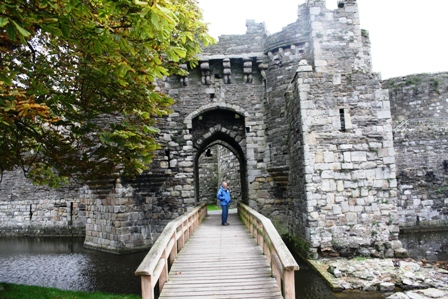
Click the photo of Beaumaris
Castle above to see an album of photos. To return to our
website, close the window
Click here to read
Harlech:
Reunion Time
The Long Journey to Llandudno 7 Sept
2011
6-7 September 2011 Llandudno Wales
“Madam, wake up, our flight has been called”. A kind fellow passenger
had recognized the sleep deprived couple had not heard the announcement
to board the plane. We quickly woke up and joined the line for our short
connecting flight from Heathrow to Manchester.
It has been a long
time since we left our home on Tuesday evening. Our last day in Ottawa
for the next two months started well. Ray and I were leaving that night
on an overnight flight to Manchester, England via Heathrow. We had three
days on our own before meeting 13 other friends for a week together at a
lodge in Harlach, Wales. We were ahead of schedule, with just a few
short chores to finish before leaving for the airport. In fact, we had
enough time for a final morning of duplicate bridge, much to the
surprise of our fellow bridge players to whom we had said good-bye last
Friday. We even managed a nice walk in the afternoon. Right on time, our
kind friend, Huib Arnold, arrived to drive us to the Ottawa airport.
From that point on our carefully laid plans started to unravel. The
flight was delayed by one hour from a late 11:35 departure to a very
late 12:30 departure. When we finally boarded the plane, the Air Canada
crew assured us we would be able to make up time on the flight over the
ocean. By the time we got through a long, tiring, overnight flight and
landed in Heathrow, we had not made up any time and the generous two
hours between flights had been whittled down to one. After a long walk
and a shuttle bus ride to the domestic flight terminal in Heathrow, the
check-in gate for our connecting flight to Manchester had been closed.
We had no choice but to stand in line and book seats on a flight leaving
two hours later. We negotiated long line-ups for both customs and
immigration and the security check and found seats amongst the multitude
of duty free shops. There we waited and waited for the gate number to be
displayed for our flight. Well past the time of our anticipated
departure our flight displayed that ominous “flight delayed” notation.
By that time I had given up trying to read as my book kept dropping when
my eyes would not stay open. Eventually the departure gate was posted
and we hustled off to yet another lounge. Not too long after the posted
boarding time we all trooped onto the plane. The flight crew explained
that the delays were caused by strong winds in England and there was now
another problem. The vehicle towing our plane onto the runway could not
disengage itself from our plane. Another service vehicle had to be
called to cut us free. We finally left at 6 PM, 4 ½ hours after our
original departure time and we still had to drive to our B&B in
Llandudno, a resort town in northern Wales.
Despite the cold rain
that was falling and the rapidly approaching night, things were looking
up. Our shuttle van to the nearby Thrifty car rental depot arrived and
our rental car was ready for us. When asked if our car ran on regular
gas or diesel, we were told it was regular gas, but we could exchange it
for a diesel fuelled car if we wished. It would be a slightly larger car
and came with GPS and would only cost another £5 per day. I thought we
would be fine with the smaller car we had originally chosen. Hindsight
always tells you what we should have done. Ray had copied the directions
to Llandudno from Google maps and gave them to me, his navigator. I
admit my navigating skills were sub-par that night. What would have been
an easy 2 hour drive in the daylight became a 4 ½ hour ride in the rain
and the dark. We didn’t have a good map of the area between the
Manchester border and Wales and I could only turn on the interior light
to read the directions for brief moments at a time. We made our first
mistake shortly after leaving the car rental office. After correcting
the first error ½ hour later by returning to our starting point, we
proceeded to miss at least three other mistakes. Ray’s favourite
expression became “we’ve seen that before”. I reminded him that whenever
we bicycle or hike he tells me that he is never lost, we are just
exploring new territory. We explored a lot of new territory that night,
but at 11:30 PM we found our B&B and the owner was still up waiting for
us. A celebration drink at a local pub was just what we needed to
unwind, regardless of the late hour. We could sleep in the next morning.
Llandudno: A Planned Resort Town
Thursday 8 Sept 2011-09-08
Wednesday
night was a decidedly young crowd of locals at the Palladium, one of the
few drinking spots still serving at 11:30 PM. The guys were dressed very
casually, the girls were fashionistas in high heels and very short
skirts. This morning we were no longer the oldest in the crowd. The
first hint was the number of people with walkers, canes and wheelchairs.
I estimated the average age of the tourists to be at least 70. Families
with children had returned home and bus tours of seniors had come to
fill the gap. We had all Thursday to explore the charms of Llandudno,
one of the most popular seaside resorts in Wales.
Llandudno
sits at the base of a small peninsula jutting into the Irish Sea. The
Mostyn family were the wealthiest 19th century landowners in
Wales, except for the Crown. The Victorian era was in full swing and
seaside holidays were high on every wealthy families list. Helped by the
Enclosure Acts, which the Mostyn family championed, tenants on the
former town common were relocated and the land was bought up. Llandudno
Bay, a broad curve two miles long, anchored on the northern end by the
rocky promontory, the Great Orme, and on the southern end by the smaller
Little Orme Head, was the perfect spot for a model resort community.
Plans were made in 1849 for the Mostyn family by a Liverpool surveyor,
Owen Williams. A broad promenade was built over the shingle banks of
Llandudno Bay, later enhanced by a broad Marine drive enabled visitors
to enjoy the sea view on foot or by carriage. A line of hotels sprung up
in a wide curve facing the bay, lots were sold and building of holiday
homes progressed over the next number of years. The town center
consisted of broad avenues laid in a grid pattern, unlike the narrow
village roads morecommon at that time. Restaurants and shops opened to
service the tourists who came in droves. The ½ mile long Llandudno Pier,
considered a Victorian marvel of wrought iron and wood opened in 1876.
The cable-drawn Great Orme Tramway, built in 1902, enabled tourists to
enjoy the view from the top of Great Orme.
Today most of the elegant three story
Victorian homes have been converted into B&Bs and small hotels. I
estimate there are more B&Bs per square mile in Llandudno than any other
town in the UK. We stayed in one of them. The modern trip to the top of
Great Orme is a ride in a cable car but the high winds and end of the
summer season had forced its closure. It was even too windy for us to
consider walking up Great Orme. We contented ourselves with strolls on
the promenade and the pier and having lunch in town. This was a day to
relax and battle the inevitable jetlag.
Touring Anglesey
Friday 9 Sept 2011
Following maps is much easier in the daytime than it is at night, but I
can still manage to send us on small detours to explore new territory.
Friday we moved on, following the coastal road west from Llandudno to
Bangor where we crossed the Menai Straits on the historical Menai
Suspension Bridge to Anglesey Island. There is a reason to choose a
small car in the UK. Bridges and roadways were not built to accommodate
larger North American style cars. In fact it took me a while to get over
my fear of imminent disaster caused by scraping the side of the car on a
stone wall or the side of another car. The other caution is the
prevalence of speed zones, all monitored by cameras laying in wait for
the driver who dares exceed the stated limits that change as we pass
through each small hamlet. We are not sure if we got caught on camera in
one town. We hope not.
Our first
stop was in Beaumaris Castle begun in 1295 by King Edward I to guard
against the marauding Welsh. After 30 years of construction, Edward got
distracted by the now warring Scots and never finished the castle.
Considered the most technically medieval castle in Britain, it is now a
World Heritage site. We spent an hour or so wandering the ruins and
enjoying the views of the Irish Sea from the ramparts. Our timing to
enjoy the many concerts on offer in Wales is off. We missed several
performances by Welsh choirs in Llandudno and workmen were at Beaumaris
setting up for an open-air Opera and Orchestra concert inside the castle
grounds. I hope the threatening rain holds off for tonight’s
performance.
We bought sandwiches for a
picnic lunch and carried on around the island on winding country roads.
We were going to go all the way to Holyhead but I directed Ray on the
wrong turnoff part way around and we headed across the island. It didn’t
really matter. We still enjoyed the sheep in the fields and the quiet
roads. We only wish we had time to explore the multitude of walking
trails that continually crossed the roads.
Lunch
ended up being in the parking lot of a beach surrounded by sand dunes.
Several other cars were taking advantage of the location for their lunch
break. An added bonus was a walking trail leading to the end of a
promontory where burial chamber dating from 2500 BC has been discovered.
We walked the short distance to peer through locked gates at a series of
standing stones inside a large chamber beneath what was originally an
earth mound. It looked very interesting. Guided tours can be arranged on
weekends and Bank Holidays but again our timing was wrong.
We continued on around the island,
crossing back over the Menai Straits on the newer Brittania Bridge and
driving a short distance to Caernarfon, where we are staying in the
Menai Bank B&B Hotel for the night. Our pub dinner last night in
Llandudno was good enough to search out another one for tonight.
Tomorrow morning we may vist another World Heritage site, Caernarfon
Castle, before joining our friends in Harlech.
Caernarfon to Harlech
10 Sept 2011
Caernarfon Castle, on the banks of the
River Seiont, is nothing to be trifled with. Edward I built his massive
stone fortress to withstand attacks from the marauding Welsh and as a
suitable home for the Head of England whenever he visited Wales. In
fact, the son of Edward I was born in Caernarfon Castle in 1284 and
Prince Charles was invested as the Prince of Wales in the castle in
1969.
Now a
World heritage Site, the castle is certainly impressive. We climbed to
the top of two towers for the view and read the history of the castle in
the excellent presentation room in the Eagle Tower. We had just an hour
to tour and I wished we had more time. Instead we did a grocery shopping
in the large Morrison Grocery and headed south through the Snowdonia.
We chose
the more scenic route to Harlech right past the base of Mt Snowdon, the
highest mountain in Wales, rather than the more direct route. It wasn’t
a day for hiking. The clouds were low over the mountains totally
obscuring the top and the few hikers we saw were soaked from the rain.
Luckily the rain stopped long enough for us to stop and take a photo of
the narrow-gauge Welsh Highland Railway pass by one of the craggy peaks
next to the road.
Soon we
were in Harlech where we met up with six of our group who had arrived
before us. The time for renewing our acquaintance with our friends had
begun.
Click here to read
Harlech: Reunion Time
Return to
Travels
Return to
Introduction